
ACS Nano
DOI: 10.1021/acsnano.8b07995


from Journals via hj on Inoreader https://ift.tt/2Iu6dnh


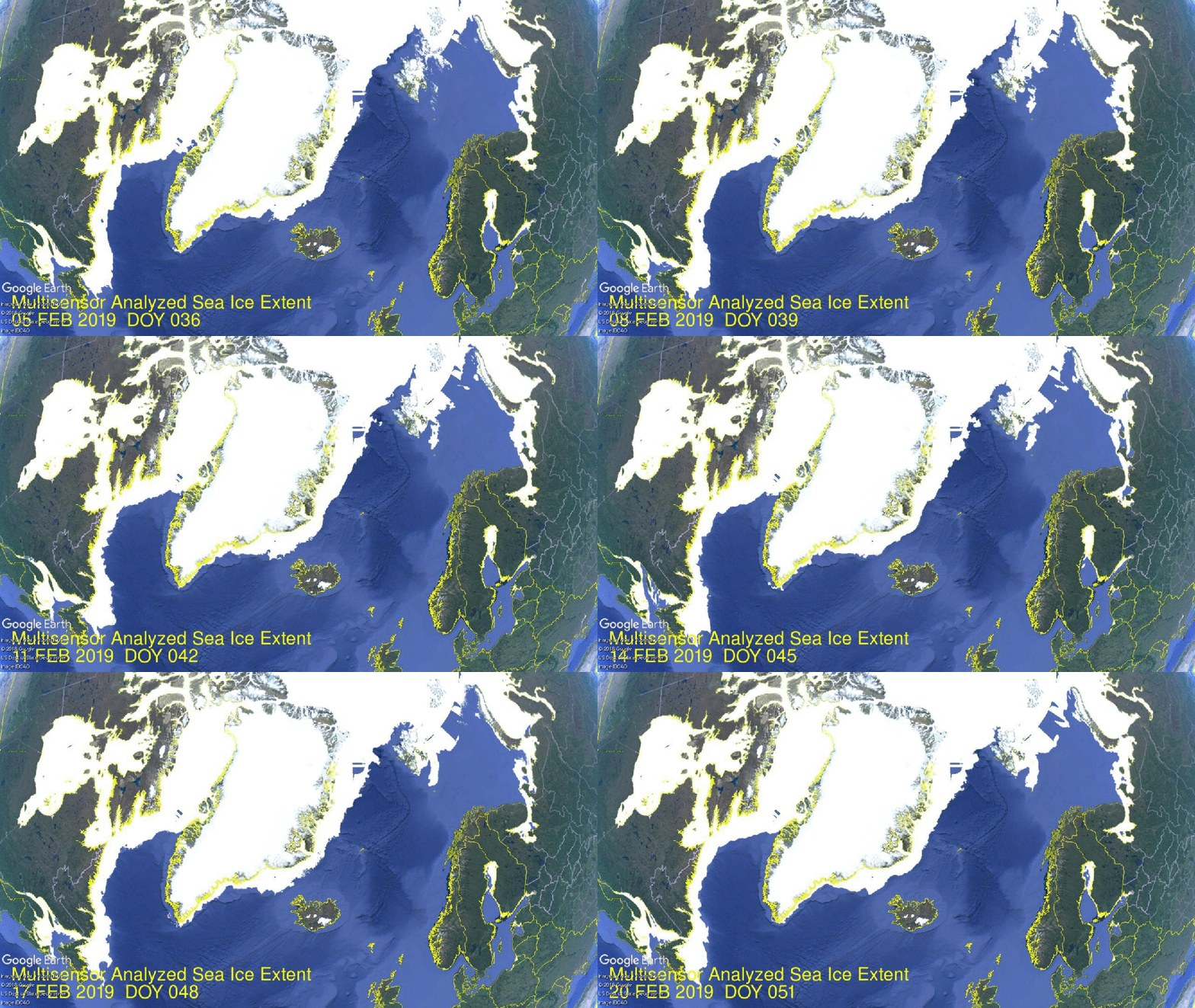
Sea Ice Extends on the Atlantic Side: The animation above shows the last two weeks on the Atlantic side, with Kara achieving its annual maximum and Barents growing ice up to 86% of its max last March. In the upper right the ice solidifies down to Svalbard and fast ice forms along the mainland. On the left, Baffin ice thickens along the Labrador coast and a large mass forms along Newfoundland. The Gulf of St. Lawrence is nearly iced over. Below is the ice recovery on the Pacific side.

Bering on the right retreats and then recovers to stay at 95% of its 2018 maximum. Meanwhile Okhotsk on the left shows a surge of sea ice, gaining almost 400k km2 over these two weeks. Bering is well below the 12 year average, while Okhotsk has already passed its 2018 maximum and is 22% above the 12 year average.
The graph below shows February progress in ice extent recovery.

2019 ice extents declined slightly to start the month, then grew rapidly in the last two weeks to nearly match the 12-year average (2007 to 2018 inclusive). SII lags MASIE by 100k km2 at this date. 2019 is presently matching 2017, and has nearly 500k km2 more ice than 2018.
Interestingly, 2019 extent has already surpassed 14.75 M km2, the 2018 maximum reached on day 74. Note in the graph that 2017 peaks on day 53, the maximum extent that year. The average maximum is 15.07 M km2 on day 62, so 2019 has 11 days more to reach that level.

The table below shows the distribution of ice in the various Arctic basins.
| Region | 2019051 | Day 051 Average | 2019-Ave. | 2018051 | 2019-2018 |
| (0) Northern_Hemisphere | 14785938 | 14847524 | -61587 | 14303929 | 482009 |
| (1) Beaufort_Sea | 1070498 | 1070200 | 297 | 1070445 | 53 |
| (2) Chukchi_Sea | 965972 | 964755 | 1217 | 955104 | 10868 |
| (3) East_Siberian_Sea | 1087137 | 1087133 | 4 | 1087120 | 18 |
| (4) Laptev_Sea | 897845 | 897842 | 3 | 897845 | 0 |
| (5) Kara_Sea | 934970 | 920340 | 14629 | 917650 | 17319 |
| (6) Barents_Sea | 685511 | 606250 | 79261 | 537870 | 147642 |
| (7) Greenland_Sea | 564543 | 619655 | -55112 | 440813 | 123730 |
| (8) Baffin_Bay_Gulf_of_St._Lawrence | 1527391 | 1487134 | 40257 | 1731868 | -204477 |
| (9) Canadian_Archipelago | 853337 | 853036 | 302 | 853109 | 229 |
| (10) Hudson_Bay | 1260903 | 1260717 | 186 | 1260838 | 66 |
| (11) Central_Arctic | 3239858 | 3210652 | 29205 | 3154998 | 84860 |
| (12) Bering_Sea | 428805 | 724586 | -295781 | 211528 | 217277 |
| (13) Baltic_Sea | 54788 | 107524 | -52735 | 85965 | -31177 |
| (14) Sea_of_Okhotsk | 1194028 | 977205 | 216823 | 1059514 | 134514 |
The table shows how 2019 is matching the 12-year average almost everywhere. Barents has edged 13% ahead of average, and is much higher than last year. The slight overall deficit is mainly due to Bering ice down nearly 300k km2 to average, only partly offset by the surplus in Okhotsk and Central Arctic.

Footnote: At his AER blog Arctic Oscillation and Polar Vortex Analysis and Forecasts Dr. Judah Cohen writes on February 18 regarding this cold winter in the Arctic and NH. Excerpts in italics with my bolds.

Figure ii. Analysis of surface temperature anomalies ffrom 18 November 2018 until 15 February 2019. Taken from https://www.esrl.noaa.gov/psd/map/clim/glbcir_rnl.shtml.
This winter once again we had what I would refer to as a highly anomalous stratospheric PV split but not as extreme as 2009 and the temperature anomalies for the winter, or certainly post the PV split are probably not going to look that terribly different from 2009. The largest negative departures are likely to be in western North America and Siberia. I will show the winter temperature anomalies with the AER forecast posted in November and from the dynamical models but for today's blog a quick and dirty surface temperature plot from NOAA will do (Figure ii). The most striking temperature anomalies are what I would consider as a couplet – strong positive temperature anomalies in the Barents-Kara Seas and strong negative temperature anomalies in Siberia. This temperature couplet has been the most consistent feature of Northern Hemisphere winters of probably the past 15-20 years. This gets to the heart of the debate does Arctic change influence mid-latitude weather. I think I have been as emphatic as anybody on the planet that the answer is yes, and this winter will only strengthen my conviction. The other continental region that is likely to have negative departures is Canada and since the PV spit the largest negative departures are centered in Western Canada.

Since November, I have consistently stated that the largest sea ice anomalies and consequently the largest positive atmospheric temperature anomalies will be in the Barents-Kara Seas. I have also discussed how surprising I find it how cold the remainder of the Arctic has been this winter. As an example, I show in Figure iii the global temperature anomalies from yesterday February 17th the https://climatereanalyzer.org/. The Arctic positive temperature departure is 0.9°C equal to the NH and global temperature departure. This is a far cry from recent winters when the Arctic has warmed at a rate six times the rate of the remainder of the globe. Ironically the globe is currently experiencing Antarctic amplification and not Arctic amplification contrary to expectations.
My thoughts about March haven't changed much since last week. The stratosphere has worked well as a predictor of North American temperature anomalies and for the most part they seem to support a continuation of cold temperatures focused in western North America. Despite this it is my own experience that cold air focused in western North America tends to shift east with time especially in the late winter. Therefore, based on this empirical observation I was expecting possibly a return to more sustained cold in the eastern US as winter winds down. This is now being predicted by both the GFS and ECMWF models. It is my experience that models may be too quick to predict a pattern change but they are often correct in anticipating the pattern change. But even assuming the eastern US turns colder, will it persist for more than just a few days? My confidence in such an outcome would increase if the Arctic finally warms something that has not really happened so far this winter.


Researchers at the University of Bonn used drill cores to trace back the fires of the past 600,000 years – favorable climate induced growth promoting larger fuel loads was the biggest factor. Highlights: Fire intensity and temperature were largest during warmer periods of earth history. The fires did not mainly occur during particularly dry periods as assumed, but in comparatively humid and…
from Climate Change Skeptic Blogs via hj on Inoreader https://ift.tt/2U7buTr
Study finds rising temperatures feed more energy to thunderstorms, less to general circulation. From MIT: Climate change is shifting the energy in the atmosphere that fuels summertime weather, which may lead to stronger thunderstorms and more stagnant conditions for mid-latitude regions of the Northern Hemisphere, including North America, Europe, and Asia, a new MIT study…
from Climate Change Skeptic Blogs via hj on Inoreader https://ift.tt/2NhZ3S5
By Paul Homewood
From Maui Now:

Nearly four years after the worst bleaching event in the state's history, coral reefs in West Hawaiʽi are stabilizing and poised to recover, according to scientists from The Nature Conservancy.
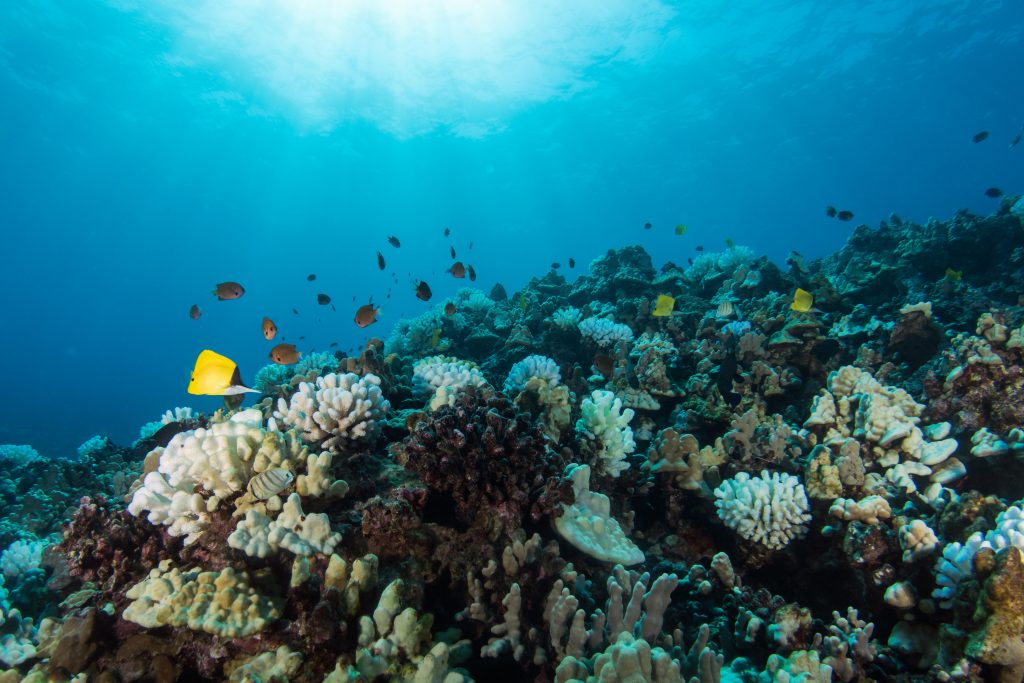
Photo: The Nature Conservancy of Hawai'i.
Higher than usual ocean water temperatures in 2015 caused the first statewide coral bleaching event. TNC surveys revealed that an average of 60% of corals in West Hawaiʻi bleached, with some reefs experiencing up to 90% mortality. Corals bleach under stress, and severe or prolonged stress can lead to death.
For the last three years, TNC scientists have studied West Hawaiʻi's coral reefs to identify the most resilient, meaning they can resist or recover from the stress of warmer ocean temperatures.
"Bleaching events like what occurred in 2015 can overstress a coral reef to the point where it may never recover," said Dr. Eric Conklin, director of marine science for TNC's Hawaiʻi program. "We surveyed over 14,000 coral colonies at 20 sites along the West Hawaiʻi coast from Kawaihae to Keauhou and were thrilled to see that many of the area's reefs have stabilized, which is the first step toward recovery."
Surveys showed that many of the most resilient reefs are in remote areas with limited shoreline access and exposure to human impacts. These reefs had lots of corals and little or no coral disease, and there was evidence that new corals were beginning to grow.
The least resilient sites all had multiple "stressors," including fishing pressure, land-based pollutants and runoff. "Interestingly, the number of stressors affecting an area, not the severity of a single one, was the most important factor," said Kim Hum, the Conservancy's marine program director. "Reefs that are fighting the impacts of several stressors are more susceptible to temperature stress, making them more likely to bleach and less able to recover if they do."
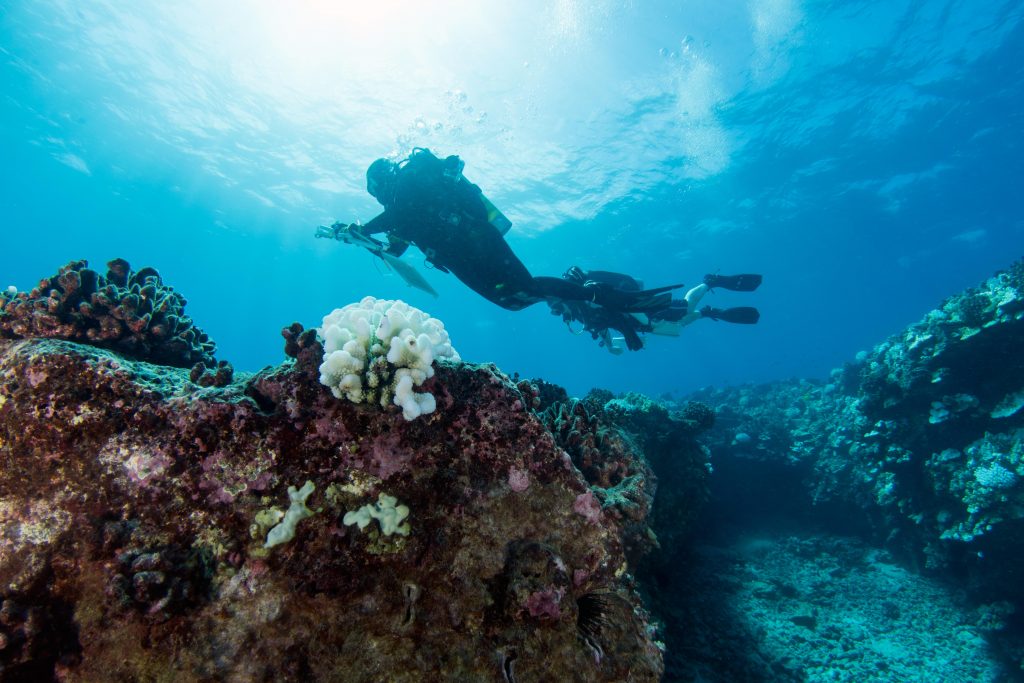
Photo: The Nature Conservancy of Hawai'i.
Surveys identified 25 coral species in West Hawaiʻi. Lobe coral (Porites lobata), one of the area's most dominant species, proved to be the most resilient—with only 50% bleaching in 2015. Cauliflower corals (Pocillopora meandrina) were hardest hit—with 98% bleaching—but recent surveys show that they are beginning to recover.
"With more frequent and severe bleaching anticipated in the years ahead, there is a lot we need to do in West Hawaiʻi and across the state to minimize the impacts of a warming climate on our reefs," Hum said. "We can make sure remote areas with few stressors stay that way, and we can reduce pressures from over-fishing, land-based pollutants and runoff in more populated areas."
Currently, only 6% of State waters (out to three nautical miles) and 12% of nearshore waters (to a depth of 50 meters) have some form of management. To ensure the long-term health of Hawaiʻi's coral reefs—and the food, jobs, and coastal protection they provide for Hawaiʻi's residents—the State has committed to effectively manage 30% of the nearshore marine environment by 2030. The results of these surveys will help determine where and how to invest to ensure that Hawaiʻi's most resilient reefs are protected.
https://mauinow.com/2019/01/22/coral-reefs-in-west-hawai%CA%BDi-showing-signs-of-recovery/
By Paul Homewood
Guido uncovers more dodgy dealings from the disgraced Gummer:

The formal inquiry into Lord Deben continues over the £600,000 in payments his family-run 'Sustainability Consultancy' Sancroft International received from taxpayer-subsidised 'Green' corporations – in what appears to be a flagrant conflict of interests with his role as Climate Change Committee chair. Now, confidential documents seen by Guido appear to show that on the very same day as Deben was arguing in Parliament in favour of expensive renewable energy subsidies, his firm was meeting with cash-guzzling, wood-pellet-burning, biomass generator Drax Group in a secret meeting that resulted in a £15,500 payment for Sancroft. Not bad for a day's work…

The debate on 30 November 2017 was on an amendment to the Renewables Obligation Order, the largest and most expensive scheme to subsidise supposedly 'low-carbon' technologies – like burning wood pellets. Drax are the biggest recipients of Renewable Obligation support in the country, receiving a whopping £481m from the taxpayer in 2017…
Combined with money from other schemes this took their total level of public support to a staggering £729m in 2017 – all for burning dirty woodchips instead of coal. Somehow they still managed to make a loss before tax of £183m that year…
Deben attempted to play down the impact that these subsidies were having on people's energy bills while arguing forcefully that Britain's manufacturing businesses should not be "let off the hook" for the costs of decarbonisation. Of course as these costs rise, so do the subsidies that go to Drax. Yet Deben made no disclosure of his relationship with Drax. In fact Guido has found at least 12 instances of him speaking in Parliament in favour of measures which benefit his private 'Green' clients without declaring his Sancroft interests…
Deben's lawyers claim that the Climate Change Committee gave Sancroft the go ahead on this project. How they ever thought it was appropriate for the Chairman of their supposedly independent committee to be receiving payments from the biggest subsidy beneficiary of them of all is extraordinary…
https://order-order.com/2019/02/21/disgraced-debens-dodgy-drax-dealings/
A tale of two Stamets, or why does Star Trek Discovery have a mushroom fetish? Continue reading →
from Climate Change Skeptic Blogs via hj on Inoreader https://ift.tt/2txsnuP
https://ift.tt/2tvxFH1 Green group denies need to register as foreign agent BY: Kevin Mooney February 16, 2019 5:00 am State Department email records show that environmental activists who have denied operating as foreign agents in response to congressional inquiries partnered with Obama administration officials to advance climate change policies that were beneficial to China and detrimental […]
from Climate Change Skeptic Blogs via hj on Inoreader https://ift.tt/2GV1tF2
https://ift.tt/2Eod51z BY TIMOTHY CAMA The Trump administration says it has cut off negotiations with California officials over the future of the nation's greenhouse gas emissions and fuel efficiency rules for cars. In a joint statement, the White House, Department of Transportation (DOT) and the Environmental Protection Agency (EPA) said the talks with California Air Resources […]
from Climate Change Skeptic Blogs via hj on Inoreader https://ift.tt/2GT4CFe
The next Australian election is coming mid year (the pollsters are calling)
The Labor opposition in Australia is doing its best to tempt us with promises they can improve the weather. They say they'll make us rich and popular too. But a former big-wig in the Australian bureaucracy thinks the bill for that will leave a third of a million people unemployed, and cost nearly half a trillion dollars.
The Labor opposition in Australia wants to make our hair-shirt 26% target into a bed of nails at 45%.
Carbon cut apocalypse: cost of ALP energy planby Simon Bensen, The Australian
Labor's 45 per cent emissions-reduction target would push electricity prices 50 per cent higher, cost workers up to $9000 a year in lower wages and wipe $472 billion from the economy over the next decade, according to the first independent modelling of the energy policies of both the government and opposition.
The Liberal (erstwhile conservative party) wants to spend $70bn on weather control.
The Coalition's commitment to meeting a 26-28 per cent reduction under the Paris Agreement would also come at a cost, with $70bn in cumulative economic losses by 2030 and a [...]

Science is Falsifiable – Clear Energy Alliance In order to know if a theory could be true, there must be a way to prove it to be false. Unfortunately, many climate change scientists, the media and activists are ignoring this cornerstone of science. In this bizarre new world, all unwelcome climate events are caused […]
from Climate Change Skeptic Blogs via hj on Inoreader https://ift.tt/2SdBXwI

This looks more like the end of the climate litigation tunnel than an oncoming train.
Finally a federal district court judge puts on his big boy pants and calls a halt to the children's climate crusade against the legal system. Climate Liability News has the story Judge Tosses Penn. Case, Says Kids Climate Cases Have No Legal Merit Excerpts in italics with my bolds.
A federal judge in Pennsylvania dismissed a climate lawsuit brought by an environmental organization and two children against the federal government. The lawsuit, Clean Air Council v. United States, claimed that Trump administration rollbacks of environmental regulations and other "anti-science" decisions violate Constitutional rights and the public trust.
In dismissing the claims on Tuesday, U.S. District Judge Paul Diamond scoffed at what he interpreted as a request that he "supervise any actions the President and his appointees take that might touch on 'the environment.'"
Beyond ruling on this case, however, Diamond went further to rebuke U.S. District Judge Ann Aiken for her ruling in Juliana v. United States that the young plaintiffs had a Constitutional right to a livable climate. When Aiken ordered that lawsuit to trial in 2016, she said "the right to a climate system capable of sustaining human life is fundamental to a free and ordered society," becoming the first U.S. judge to recognize that right.
Diamond said that ruling is at odds with previous court decisions and "the Juliana Court certainly contravened or ignored longstanding authority."
He also took issue with what guaranteeing a stable climate would entail, calling it "without apparent limit."
In dismissing the case before him, Diamond said the Pennsylvania plaintiffs, who filed the suit in 2017, lacked standing. The two boys said their serious allergies and asthma were directly linked to the impacts of climate change, but Diamond said they failed to directly tie their injuries to government actions. Diamond said he interpreted this case as a political dispute. "Plaintiffs' disagreement with Defendants is a policy debate best left to the political process," he wrote.
Diamond was appointed to his post by President George W. Bush in 2004.
The Clean Air Council said in a statement it "respectfully disagrees with the decision" and is discussing the next steps with its counsel.
"The Trump administration continues to rely on junk science to implement reckless climate change policies in the face of indisputable U.S. and international scientific consensus. For decades, the U.S. government has acknowledged that climate change presents a clear and present danger to life, and represents an urgent and potentially irreversible threat to human societies and the planet. These acts of deliberate indifference are increasing U.S. contributions to climate change, thereby increasing the frequency and intensity of its life-threatening effects, and violating our constitutional rights," said Joseph Otis Minott, executive director and chief counsel of the Clean Air Council.
"We are troubled that the opinion states the federal government 'do[es] not produce greenhouse gases' and that 'climate change is the creation of those that pollute the air, not the Government,'" he added. "These statements are both irrelevant to our claims and factually incorrect."
Diamond made clear he does not see a role for the judiciary in climate policy and argued that Aiken's recognition of the public trust claims in Juliana was an incorrect expansion of that doctrine beyond its traditional concept governing only navigable waters.
"Plaintiffs seek to create an entirely new doctrine—investing the Federal Government with an affirmative duty to protect all land and resources within the United States," Diamond wrote. "The Juliana Court alone has recognized this new doctrine. Again, that Court's reasoning is less than persuasive."


