| New research into approach/avoidance conflict P Vijayalakshmi Archives of Mental Health 2018 19(2):51-51 | |||||||||||||||||||||||||||||||||||||||||||||||||||||||||||||||||||||||||||||||||||||||||||||||||||||||||||||||||||||||||||||||||||||||||||||||||||||||||||||||||||||||||||||||||||||||||||||||||||||||||||||||||||||||||||||||||||||||||||||||||||||||||||||||||||||||||||||||||||||||||||||||||||||||||||||||||||||||||||||||||||||||||||||||||||||||||||||||||||||||||||||||||||||||||||||||||||||||||||||||||||||||||||||||||
| "PUT A SIGN HERE and PUT A SIGN THERE!" (obtaining informed consent is not so easy in this changed litigious world) Rama Reddy Karri Archives of Mental Health 2018 19(2):52-53 | |||||||||||||||||||||||||||||||||||||||||||||||||||||||||||||||||||||||||||||||||||||||||||||||||||||||||||||||||||||||||||||||||||||||||||||||||||||||||||||||||||||||||||||||||||||||||||||||||||||||||||||||||||||||||||||||||||||||||||||||||||||||||||||||||||||||||||||||||||||||||||||||||||||||||||||||||||||||||||||||||||||||||||||||||||||||||||||||||||||||||||||||||||||||||||||||||||||||||||||||||||||||||||||||||
| APPSYCON Kakinada - "Extending with interventions" P Srinivasa Teja Archives of Mental Health 2018 19(2):54-56 | |||||||||||||||||||||||||||||||||||||||||||||||||||||||||||||||||||||||||||||||||||||||||||||||||||||||||||||||||||||||||||||||||||||||||||||||||||||||||||||||||||||||||||||||||||||||||||||||||||||||||||||||||||||||||||||||||||||||||||||||||||||||||||||||||||||||||||||||||||||||||||||||||||||||||||||||||||||||||||||||||||||||||||||||||||||||||||||||||||||||||||||||||||||||||||||||||||||||||||||||||||||||||||||||||
| The mystery of the missing dream in psychiatry (DS Raju Memorial Oration at IPS-AP State Conference Kakinada) M S. V. K. Raju Archives of Mental Health 2018 19(2):57-63 | |||||||||||||||||||||||||||||||||||||||||||||||||||||||||||||||||||||||||||||||||||||||||||||||||||||||||||||||||||||||||||||||||||||||||||||||||||||||||||||||||||||||||||||||||||||||||||||||||||||||||||||||||||||||||||||||||||||||||||||||||||||||||||||||||||||||||||||||||||||||||||||||||||||||||||||||||||||||||||||||||||||||||||||||||||||||||||||||||||||||||||||||||||||||||||||||||||||||||||||||||||||||||||||||||
| The role of human touch in psychiatry (Manasa Oration IPS-AP State conference Kakinada) M Vijaya Gopal Archives of Mental Health 2018 19(2):64-69 | |||||||||||||||||||||||||||||||||||||||||||||||||||||||||||||||||||||||||||||||||||||||||||||||||||||||||||||||||||||||||||||||||||||||||||||||||||||||||||||||||||||||||||||||||||||||||||||||||||||||||||||||||||||||||||||||||||||||||||||||||||||||||||||||||||||||||||||||||||||||||||||||||||||||||||||||||||||||||||||||||||||||||||||||||||||||||||||||||||||||||||||||||||||||||||||||||||||||||||||||||||||||||||||||||
| A review of functional gastrointestinal disorders: A primer for mental health professionals Suhas Chandran, SN Prakrithi, Supriya Mathur, M Kishor, T S. Sathyanarayana Rao Archives of Mental Health 2018 19(2):70-81 Functional gastrointestinal disorders (FGIDs) are chronic, recurrent, frequently debilitating disorders with no identifiable underlying pathology. They occur due to a complex interplay between biological, psychological, and social factors and are some of the most common conditions encountered in general clinical practice as well as the specialist gastroenterological clinic. The top-down regulation of visceral sensations plays an important role in the pathophysiology of the disease, i.e., the central processing of emotions and stressors altering the sensory and motor components of the gut, which increases hypersensitivity and therefore symptom severity. In addition, the core personality traits of the individual play their part in the way symptoms are perceived, further providing proof for the long-prevailing belief that the gut and emotions are linked, the so-called “gut feeling.” The current diagnostic criteria for FGIDs are entirely based on subjective symptoms, challenging in itself due to the varied presentations, and further complicated by the current unavailability of objective laboratory tests which could confirm its presence in the symptomatic individual. The various treatment modalities include psychotherapies ranging from cognitive behavioral therapy to mindfulness, along with appropriate pharmacotherapy to treat physical and psychiatric comorbidities. Addressing all these underlying causes, in addition to weighing in the genetic makeup of the individual, is necessary for delineating accurate prognosis, reducing attending health-care costs, and improving overall outcome of the individual. | |||||||||||||||||||||||||||||||||||||||||||||||||||||||||||||||||||||||||||||||||||||||||||||||||||||||||||||||||||||||||||||||||||||||||||||||||||||||||||||||||||||||||||||||||||||||||||||||||||||||||||||||||||||||||||||||||||||||||||||||||||||||||||||||||||||||||||||||||||||||||||||||||||||||||||||||||||||||||||||||||||||||||||||||||||||||||||||||||||||||||||||||||||||||||||||||||||||||||||||||||||||||||||||||||
| Therapeutic intervention for children through play: An overview Basavaraj Shrinivasa, Madina Bukhari, G Ragesh, Ameer Hamza Archives of Mental Health 2018 19(2):82-89 Play is children's innate mode of self-expression and a method through which they explore the world. It has important implication for overall (physical, psychological, and psychosocial) development of any children. Play therapy capitalizes on such therapeutic powers or changing mechanisms within play and considers its strategic use through trained professionals to promote specific therapeutic outcomes within therapeutic contexts. This review article aims to provide a brief description on the use of play as therapeutic agent for change, different processes expressed in play, therapeutic powers within the play, and major approaches to play therapy. An attempt has also been made to list out some of the research studies from the available literature to prove the efficacy of play therapy in different conditions. The article concludes with highlighting the current issues and challenges faced by play therapy practice as a therapeutic medium to be used with children and way forward has been suggested. | |||||||||||||||||||||||||||||||||||||||||||||||||||||||||||||||||||||||||||||||||||||||||||||||||||||||||||||||||||||||||||||||||||||||||||||||||||||||||||||||||||||||||||||||||||||||||||||||||||||||||||||||||||||||||||||||||||||||||||||||||||||||||||||||||||||||||||||||||||||||||||||||||||||||||||||||||||||||||||||||||||||||||||||||||||||||||||||||||||||||||||||||||||||||||||||||||||||||||||||||||||||||||||||||||
| Impact of psychosocial paradigms on gender equality Abdul Raffie Naik, Tejaswini Padikkal Archives of Mental Health 2018 19(2):90-94 Gender is the social, behavioral, and cultural attributes, expectations, and norms associated with being a woman or a man. The aim of gender equality is the empowerment of women, thus enabling them to manage their lives. Gender equality is a fundamental issue. The lives of people are heavily influenced by the societal stereotyping of gender. While there are differences in the biological makeup of men and women, the gender roles that are played are determined both socially and culturally. Despite major changes in the attitudes of people over the years, the issue of gender is still very much alive in society today. Gender inequalities impact women over their lifetime, their health, educational attainment, and economic conditions. Gender equality will be achieved only when women and men enjoy the same opportunities, rights, and obligations in all spheres of life. The paper is a study on the existing literature on gender and equality to understand the existing social and psychological paradigms that act as a barrier to equality among the different genders. The present study aims at understanding an overall picture of the psychosocial paradigms that infringe on gender equality. Journal articles and texts on gender inequality were identified and reviewed. psychological, sociological, and psychosocial perspectives of gender inequality are presented in the paper. Gender inequality in health, education, and work is present to date. | |||||||||||||||||||||||||||||||||||||||||||||||||||||||||||||||||||||||||||||||||||||||||||||||||||||||||||||||||||||||||||||||||||||||||||||||||||||||||||||||||||||||||||||||||||||||||||||||||||||||||||||||||||||||||||||||||||||||||||||||||||||||||||||||||||||||||||||||||||||||||||||||||||||||||||||||||||||||||||||||||||||||||||||||||||||||||||||||||||||||||||||||||||||||||||||||||||||||||||||||||||||||||||||||||
| Mental health issues in Kashmir valley: An overview Rizwan Hassan Bhat, Shah Mohd Khan Archives of Mental Health 2018 19(2):95-96 Most mental health researchers believe that there is a variety of contributing factors to the onset of mental health issues. Studies have found that there are physical, social, environmental, and psychological causes. This paper highlights some of the mental health issues that are prevailing in Kashmir. The research so far conducted in the valley has pointed social, environmental, and psychological issues prevailing in general in the Kashmir Valley. The prevailing disturbances in the valley from the past two decades of turmoil in Kashmir were cited by most researchers as the main reasons for mental health problems. Apart from this, the changing political parties, ethics to divide, and rule resulting economic dynamics of inhabitants are also responsible for this menace. Depression, posttraumatic stress disorder, obsessive-compulsive disorder, stress, and anxiety are diagnosed in general to cause mental trauma, and illness. | |||||||||||||||||||||||||||||||||||||||||||||||||||||||||||||||||||||||||||||||||||||||||||||||||||||||||||||||||||||||||||||||||||||||||||||||||||||||||||||||||||||||||||||||||||||||||||||||||||||||||||||||||||||||||||||||||||||||||||||||||||||||||||||||||||||||||||||||||||||||||||||||||||||||||||||||||||||||||||||||||||||||||||||||||||||||||||||||||||||||||||||||||||||||||||||||||||||||||||||||||||||||||||||||||
| Impact of traumatic brain injury on cognitive functions Padilla-Zambrano Huber Said, Amrita Ghosh, Ranabir Pal, Nataraja Poli, Luis Rafael Moscote-Salazar, Amit Agrawal Archives of Mental Health 2018 19(2):97-101 In this systematic review, we summarize the current understanding and controversies on cognitive sequelae after traumatic brain injury (TBI) to understand the cognitive deficits such as memory, attention, executive functions, and unawareness of their deficits in TBI patients. This review presents the cognitive sequel of patients with moderate-to-severe TBI by a comprehensive focused conglomeration of research publications by searching various resources. A search strategy with specific inclusion criteria was performed in PubMed, Cochrane, Web of Science, and the WHO Global Health Library. This review noted that TBI is related with increase of various neurological and non-neurological disorders including problems with attention, inability to concentrate, speech and language dysfunctions, learning and memory impairment, impaired reasoning, impaired planning and problem-solving. This review found that patients' cognitive deficits are common in victims of moderate to severe TBI often as the long-lasting sequalae. The present review suggests that there is a need for further research to develop unique rehabilitation methods that will help to enhance brain plasticity and process of recovery after TBI.
| |||||||||||||||||||||||||||||||||||||||||||||||||||||||||||||||||||||||||||||||||||||||||||||||||||||||||||||||||||||||||||||||||||||||||||||||||||||||||||||||||||||||||||||||||||||||||||||||||||||||||||||||||||||||||||||||||||||||||||||||||||||||||||||||||||||||||||||||||||||||||||||||||||||||||||||||||||||||||||||||||||||||||||||||||||||||||||||||||||||||||||||||||||||||||||||||||||||||||||||||||||||||||||||||||
Tuesday, January 1, 2019
Mental Health


Fabrication and photocatalytic performance evaluation of hydrodynamic erosion–resistant nano-TiO 2 –silicone resin composite films
Abstract
Herein, we present the preparation of nano-TiO2–silicone resin composite films by double liquid phase spray deposition. The films exhibit better adhesion stability and photocatalytic activity under a hydrodynamic erosion condition than conventional nano-TiO2 composite films. The TiO2 layer morphology and effective TiO2 coverage ratio (CR) were affected by the initial curing time (ICT) of the silicone resin, e.g., the increase in an ICT from 10 to 40 min resulted in a CR change from 79.1 to 98.7%. The surface morphology evolution of composite films was studied under a hydrodynamic erosion period of 4 weeks. Obtained results allowed the 4-week evolution to be divided into four stages (pitting, crack pregnant, banded stripping, and surface stripping periods), additionally revealed that the CR of all samples was remained above 65%. The photocatalytic activity of composite films before and after 4-week hydrodynamic erosion was evaluated by rhodamine B degradation experiments. The 4-week erosion only led to the decrease of the photodegradation efficiencies by less than 40% in all cases. Thus, the fabricated TiO2–silicone composite films demonstrated excellent durability and photocatalytic activity under the conditions of long-term hydrodynamic erosion, allowing one to conclude that this work paves the way to the fabrication of next-generation photocatalytic materials for industrial applications.
from Climate Change Skeptic Blogs via hj on Inoreader http://bit.ly/2F2LILT
Exogenous application of Ca 2+ mitigates simulated acid rain stress on soybean productivity and quality by maintaining nutrient absorption
Abstract
Acid rain is a global environmental problem that threatens agricultural production. Calcium (Ca), as a signal substance for physiological activities, has been known to regulate plant growth under abiotic stresses. To clarify whether calcium could be one of possible ways to alleviate the reduction caused by acid rain in agricultural production and investigate its regulating mechanism on adaptation of plants under acid rain stress, we studied the effect of exogenous Ca2+ (5 mM CaCl2) on growth of soybean at different growth stages (seedling, flowering-podding, and filling stages) as well as yield and grain quality of soybean under simulated acid rain (pH 4.5 or pH 3.0) stress. We found that the application of Ca2+ could regulate the activity of plasma membrane H+-ATPase, for mitigating the increase of ammonium and the decrease of nitrate and phosphorus in soybean roots, which mitigated the inhibition on growth and improved the yield and grain quality of soybean under simulated acid rain stress. In addition, the alleviating effect of exogenous Ca2+ on soybean was the most significant at seedling stage. The results indicate that the exogenous Ca2+ could enhance the adaptation of soybean and facilitate the recovery of soybean productivity and grain quality under simulated acid rain stress by maintaining the uptake of nitrate, ammonium, and phosphorus.
from Climate Change Skeptic Blogs via hj on Inoreader http://bit.ly/2F2Tm8c
Hydroxyl free radical route to the stable siliceous Ti-UTL with extra-large pores for oxidative desulfurization
Chem. Commun., 2019, Accepted Manuscript
DOI: 10.1039/C8CC09225G, Communication
DOI: 10.1039/C8CC09225G, Communication
Dier Shi, Le Xu, Pohua Chen, tianqiong ma, Cong Lin, Xiaoge Wang, Diming Xu, Junliang Sun
A facile and mild method was successfully developed to prepare the stable, high siliceous Ti-UTL zeolite with extra-large pores. The hydroxyl free radical (⋅OH) was introduced for the first time...
The content of this RSS Feed (c) The Royal Society of Chemistry
A facile and mild method was successfully developed to prepare the stable, high siliceous Ti-UTL zeolite with extra-large pores. The hydroxyl free radical (⋅OH) was introduced for the first time...
The content of this RSS Feed (c) The Royal Society of Chemistry

from Journals via hj on Inoreader https://rsc.li/2s2ogWy
Highly adsorptive chitosan/saponin-bentonite composite film for removal of methyl orange and Cr(VI)
Abstract
Robust and simple composite films for the removal of methyl orange (MO) and Cr(VI) have been prepared by combining chitosan, saponin, and bentonite at a specific ratio. There are several composite films (chitosan-saponin-bentonite (CSB)) prepared; among them, the composite films CSB2:3 and CSB1:1 have the highest removal efficiency toward MO and Cr(VI) where the maximum removal is 70.4% (pH 4.80) and 92.3% (pH 5.30), respectively. It was found that different types of adsorbate have different thermodynamic properties of the adsorption process; the adsorption of MO onto CSB2:3, chitosan, and acid-activated bentonite (AAB) proceeded endothermically, while the adsorption of Cr(VI) onto CSB1:1, chitosan, and AAB proceeded exothermically. The parameters of the adsorption were modeled by using isotherm and kinetic equations. The models of Langmuir, Freundlich, Redlich-Peterson, Sips, and Toth were used for fitting the adsorption isotherm data at a temperature of 30, 45, and 60 °C; all of the isotherm models could represent the data well. The result indicates that CSB2:3 has the highest adsorption capacity toward MO with qm of 360.90 mg g−1 at 60 °C; meanwhile, CSB1:1 has the highest adsorption capacity toward Cr(VI) with qm 641.99 mg g−1 at 30 °C. The pseudo-second-order model could represent the adsorption kinetics data better than the pseudo-first-order equation. The adsorption mechanism was proposed, and the thermodynamic properties of the adsorption were also studied.
from Climate Change Skeptic Blogs via hj on Inoreader http://bit.ly/2Vh8WCW
Climate Change Friendly Green Steel: “Society Would Have to Accept Higher Costs”

from Climate Change Skeptic Blogs via hj on Inoreader http://bit.ly/2QeSTC4
Under current policies, residential batteries increase emissions in most cases

from Climate Change Skeptic Blogs via hj on Inoreader http://bit.ly/2ApvNTU
5 Ways to Help Your Office Recycle
The key is to make recycling a company-wide habit, make it part of your company's culture, so eventually it's a thing that people do without thinking a lot about it.
from Climate Change Skeptic Blogs via hj on Inoreader http://bit.ly/2SujOM3
Can wind and solar replace fossil fuels?

from Climate Change Skeptic Blogs via hj on Inoreader http://bit.ly/2GPtzTN
More wind and solar than SA can use — we threw away 10% of the generation
But we have so much wind power, too much, that in South Australia the AEMO had to intervene to curtail excess wind and solar generation. (This curtailment wouldn't need to happen if people weren't so persnickety about blackouts. Honestly, South Australia where are the Blackouts to save the world!)
This graph is from the Quarter 3 AEMO report for 2018. It is technically about both wind and solar, but it appears to be mostly wind. Solar is not a star player in Q3 because it's winter.
Would we put up with any other industrial output that had such a dismal performance. Imagine this was your car….
AEMO Quarter 3 report page 7
Synchronous generation is the kind that comes from machines that spin at 50 Hz (like coal, gas, hydro, nukes). These keep the system stable. Happy happy.
Ten percent of all the wind and solar power had to be thrown away in SA because there wasn't enough reliable back up power to guarantee the stability of the system.
During Q3 2018, total curtailments of non-synchronous generation (large-scale wind and solar farms) in South Australia increased to around 150 GWh (or 10% of South Australian non-synchronous generation) [...]

Rating: 0.0/10 (0 votes cast)
from Climate Change Skeptic Blogs via hj on Inoreader http://bit.ly/2EZpJ7S
Happy Arctic New Year 2019

With the end of December, Arctic ice is rebuilding in the dark up to its annual maximum before the beginning of dawn in March. Since many of the seas are already at their maximum extents, the coming months will only add about 2M km2 to the approximately 13M km2 of ice in place.

The map above shows the remarkable growth of Bering Sea ice in December. The Bering ice extent grew from 57k km2 to 459k km2 yesterday, exceeding the March Bering maximum of 451k km2. Okhotsk has grown ice more slowly, now at 347k km2 slightly below average. Note Chukchi Sea north of Bering froze completely as of day 350.
The regrowth of Arctic ice extent was slower than usual until recently. After showing resilience in September, ending higher than 2007, ice growth lagged in October, then recovered in November and kept pace with average through most of December.

In December, 2018 ice extent has grown by close to 11 year average until the last 10 days. As of Dec. 31, 2018 ice extent is ~300k km2 (2%) less than average (2007 to 2017). The chart also shows the variability of ice extent over the years during this month. 2007 ramped up to match average, while 2017 was almost 200k km2 lower than 2018 at year end. SII is showing 2018 lower than MASIE 2018, closely matching MASIE 2017.

The table below shows this year compared to average and to 2017 for day 365. Since several years in the dataset were missing day 365, I am making the comparison a day later.
| Region | 2018365 | Day 365 Average | 2018-Ave. | 2017365 | 2018-2017 |
| (0) Northern_Hemisphere | 12805066 | 13107229 | -302163 | 12628187 | 176880 |
| (1) Beaufort_Sea | 1070498 | 1070245 | 253 | 1070445 | 53 |
| (2) Chukchi_Sea | 966006 | 963990 | 2016 | 943883 | 22124 |
| (3) East_Siberian_Sea | 1087137 | 1087133 | 5 | 1087120 | 18 |
| (4) Laptev_Sea | 897845 | 897842 | 3 | 897845 | 0 |
| (5) Kara_Sea | 773183 | 889865 | -116682 | 892689 | -119507 |
| (6) Barents_Sea | 261190 | 437725 | -176534 | 331819 | -70629 |
| (7) Greenland_Sea | 522009 | 582349 | -60340 | 555757 | -33748 |
| (8) Baffin_Bay_Gulf_of_St._Lawrence | 1069626 | 1023935 | 45691 | 978074 | 91552 |
| (9) Canadian_Archipelago | 853337 | 853059 | 279 | 853109 | 229 |
| (10) Hudson_Bay | 1260903 | 1230818 | 30086 | 1260838 | 66 |
| (11) Central_Arctic | 3194383 | 3206157 | -11774 | 3191526 | 2858 |
| (12) Bering_Sea | 458758 | 422870 | 35888 | 194350 | 264408 |
| (13) Baltic_Sea | 20842 | 35624 | -14782 | 13345 | 7497 |
| (14) Sea_of_Okhotsk | 347016 | 375834 | -28818 | 336595 | 10421 |
The main deficit to average is in Barents and Kara Seas on the Atlantic side, partly offset by surpluses in Hudson and Baffin Bays and in Bering Sea on the Pacific side. Note the huge increase in Bering ice this year compared to 2017. This coincides with the disappearing warm water Blob in the North Pacific, as reported by Cliff Mass.The Canadian and Siberian sides are locked in ice, with sizable surpluses in Baffin Bay and Okhotsk Sea.
No one knows what will happen to Arctic ice.
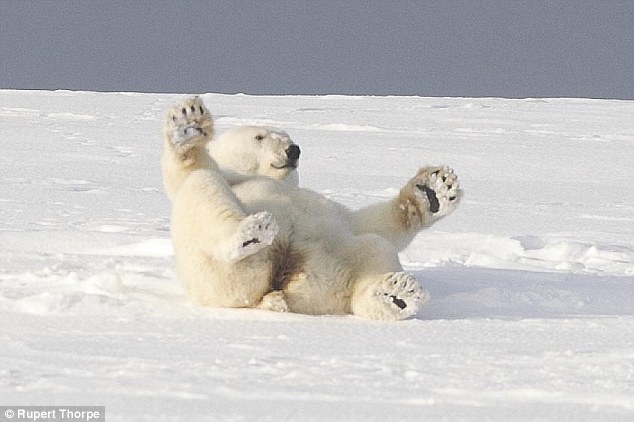
Except maybe the polar bears.
And they are not talking.
Except, of course, to the admen from Coca-Cola

Summary
There is no need to panic over Arctic ice this year, or any year. It fluctuates according to its own ocean-ice-atmospheric processes and we can only watch and be surprised since we know so little about how it all works. Judah Cohen at AER thinks much greater snowfall in October and since will make for a very cold winter. We shall see. It is already adding more mass to the Greenland ice sheet than in previous years.

See Natural Climate Factors: Snow
In any case, the early and extensive ice in the Canadian Arctic regions was well received by our polar bears.
from Climate Change Skeptic Blogs via hj on Inoreader http://bit.ly/2Rpy8YL
Tale Of Two Stations…Striking Contrast: Urban Tokyo Warms Strongly While Rural Island Station Shows No Warming

Hachijojima is a rural-type island off the coast from the megapolis of Tokyo in the Pacific.
What makes Hachijojima interesting is that it is ideal for comparing its trend to a heavily urban environment, like Tokyo's.
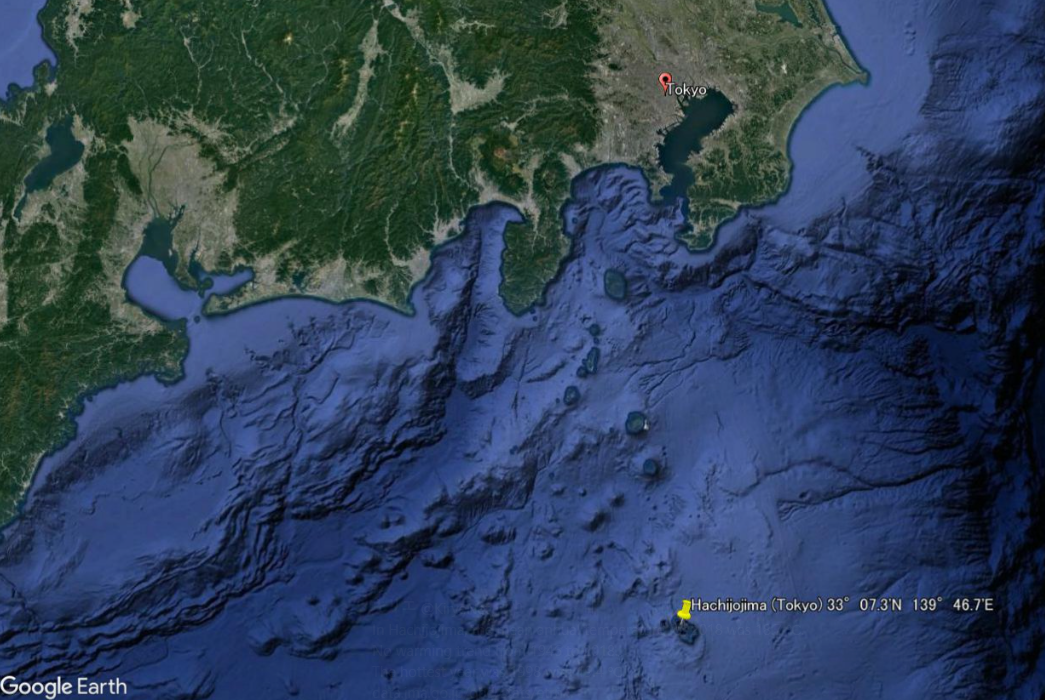
Hachijojima is located roughly 300 km, out to sea, from Tokyo and thus is hardly impacted by urbanization. Image: Google Earth.
What follows is a close up of the island and the approximate location of the measurement station:

Hachijojima is relatively very rural and unaffected from the factors of urbanization. Image: Google Earth
Such a comparison can allow us to see the urban signal on measured data, like temperature. The following chart shows that there has been no warming at this island over the past 70 years, using the unadjusted data from the Japanese Meteorology Agency (JMA):

There's been no trend at all in the mean annual temperature at Hachijojima over the past 70 years! Chart: Kirye.
Now when we compare rural Hachijojima to massively urban Tokyo, using the mean daily maximum temperature, we can clearly see the urban heat island (UHI) effect:
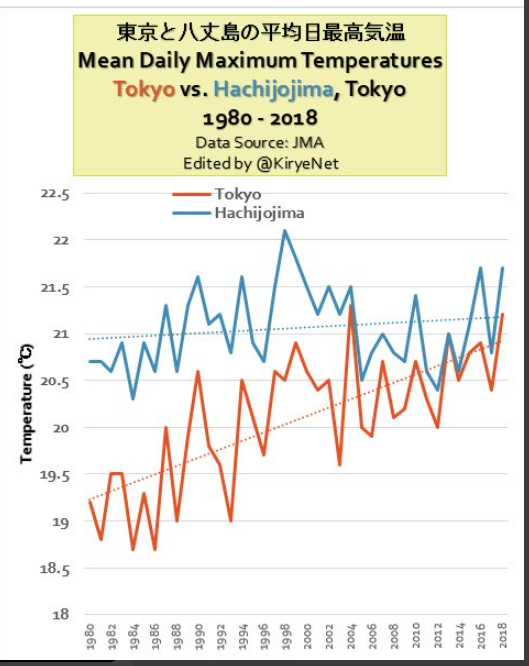
While Hachijojima has seen no only a modest warming trend since 1980, modern urban Tokyo has seen a strong warming. This is very likely due to the urban heat island effect where steel, concrete and asphalt store energy from the sun and fuels consumed by cars, buildings and factories. Chart: Kirye.
UHI effect since start of Japanese industrialization
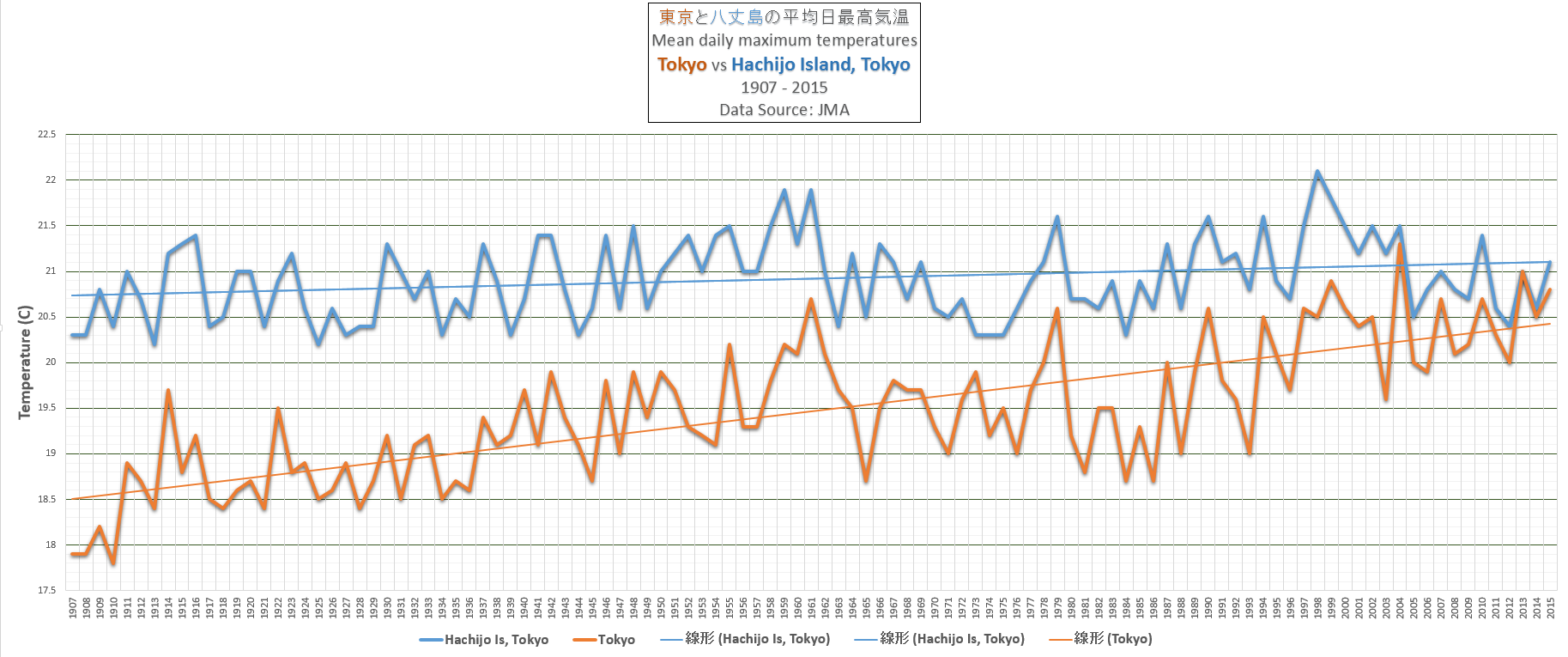
The data for both stations go way back to 1907:
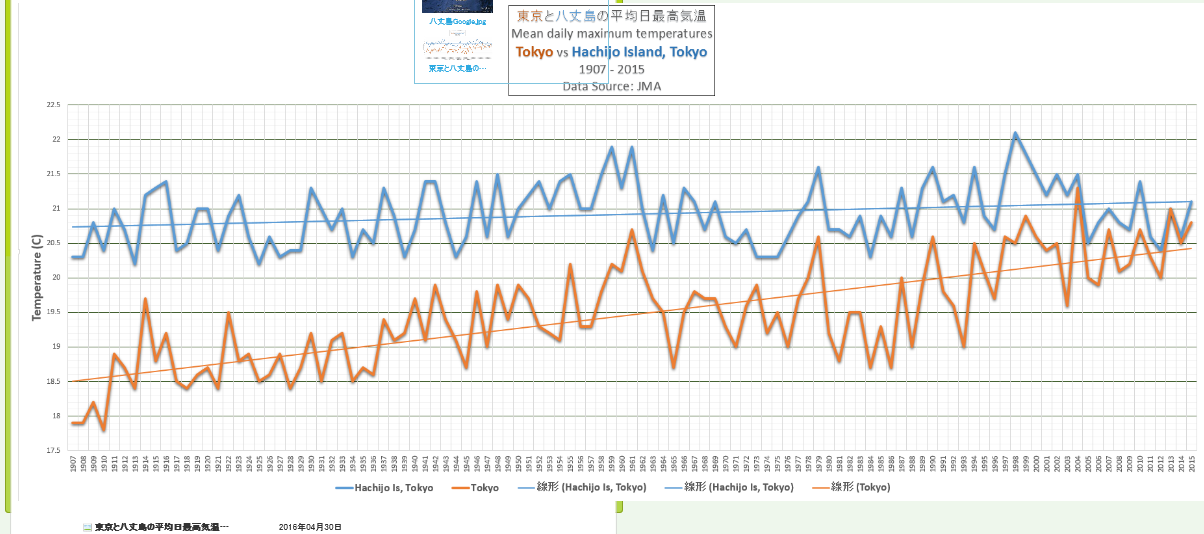
Click here to enlarge. Chart: Kirye.
From 1907 to 1935, the trend for both was very similar, with no rise. Then there was a rise for both stations from the 1930s to 1961. Note how in this period Tokyo temperature rose more quickly than Hachijojima. Next came the cooling of the the 1960s, 1970s and early 1980s, followed by the most recent warming.
Tokyo warms, while rural island cools!
Note how the most recent warming since the 1980s has been far stronger in Tokyo then it has been in rural Hachijojima. Tokyo, once significantly cooler, is about as warm as Hachijojima today.
And since the peak in 1998, Hachijojima has been cooling a bit while Tokyo has been warming!
Can all this be explained by CO2? Honestly not.
Obviously the urban heat island (UHI) effect is the real driver in Tokyo and is corrupting urban data, while natural ocean factors may be at work to account for the difference as well.
=====================================================
Pierre Gosselin contributed to this article
from Climate Change Skeptic Blogs via hj on Inoreader http://bit.ly/2SCvuw4
Top 12 Debunked Climate Scares of 2018 – New studies refute claims about temperature, ice, sea level rise, extreme weather and corals
Top 12 Debunked Climate Scares of 2018 http://bit.ly/2QfQWFz Round up of scares via The Global Warming Policy Forum (GWPF) Top 12 Debunked Climate Scares of 2018 by bennypeiser / Yesterday, 03:41 January 2018: Worst-case global warming scenarios not credible: Study PARIS (AFP) – Earth's surface will almost certainly not warm up four or five degrees [...]
from Climate Change Skeptic Blogs via hj on Inoreader http://bit.ly/2F17G23
2018 is the first year with no violent tornadoes in USA – 5 years without an EF-5 tornado & number of EF-3 tornadoes will be a record low as well
2018 is the first year with no violent tornadoes in the United States http://bit.ly/2GRqCSy NOT A LOT OF PEOPLE KNOW THAT 2018 is the first year with no violent tornadoes in the United States by Paul Homewood / Today, 07:07 By Paul Homewood Last week, the Washington Post picked up on the likelihood that 2018 [...]
from Climate Change Skeptic Blogs via hj on Inoreader http://bit.ly/2F0NE7B
Greenpeace’s Iconic ‘Rainbow Warrior’ Ship Chopped Up On A Third-World Beach, Sold For Scrap
Greenpeace's Iconic 'Rainbow Warrior' Ship Chopped Up On A Third-World Beach, Sold For Scrap http://bit.ly/2ArLqdH From The Daily Caller 8:11 PM 12/30/2018 | Energy Michael Bastasch | Energy Editor Greenpeace's iconic "Rainbow Warrior" boat was disposed of in a way the group campaigned against for years. Greenpeace regrets allowing its old vessel to be chopped [...]
from Climate Change Skeptic Blogs via hj on Inoreader http://bit.ly/2F0Hbca
COP 24: Good news — The big moves failed at the UN climate summit
COP 24: Good news — The big moves failed at the UN climate summit http://bit.ly/2F0zOl5 There were two big ticket action items that, while not officially on the agenda, were still center stage. In fact they were all the green press talked about. The post COP 24: Good news — The big moves failed at [...]
from Climate Change Skeptic Blogs via hj on Inoreader http://bit.ly/2F0Nw87
12,000 police on duty in Paris as ‘yellow vests’ call protests…
12,000 police on duty in Paris as 'yellow vests' call protests… https://yhoo.it/2BPahrO 12,000 police on duty in Paris as 'yellow vests' call protests Paris (AFP) – Nearly 150,000 police are set to be on duty around France on New Year's Eve when "yellow vest" protesters have called for another round of anti-government demonstrations. The French [...]
from Climate Change Skeptic Blogs via hj on Inoreader http://bit.ly/2EXBBbv
Chuck Todd Bans ‘Climate Deniers’ from Climate Change Special
Chuck Todd Bans 'Climate Deniers' from Climate Change Special http://bit.ly/2GIkUSS The Closing of the American Mind was Allan Bloom's groundbreaking critique of "absolute understanding" in academia and the way that it undermines critical thinking. If Bloom were with us today, we could imagine him writing a sequel devoted to the way the climate change industry [...]
from Climate Change Skeptic Blogs via hj on Inoreader http://bit.ly/2F0vMKc
NY Times claims ‘Trump imperils planet’ with carbon emissions, but still plans own private jet use
NY Times claims 'Trump imperils planet' with carbon emissions, but still plans own private jet use http://bit.ly/2CEz5V3 Private jets – the cherished perk of the ruling class — may be the Achilles Heel of their campaign to control carbon emissions in the name of global warming. — gReader Pro
from Climate Change Skeptic Blogs via hj on Inoreader http://bit.ly/2F1ldqs
More Tornadoes? Capital Weather Gang Plug Flawed NOAA Study
By Paul Homewood

As I noted earlier today, the Washington Post's Capital Weather Gang have reported that last year is the first on record to have no EF-4 and EF-5 tornadoes in the US.
The Capital Weather Gang long ago sold their souls to the global warming religion, and are usually very loathe to admit that sometimes the weather might be better because of a bit of warming.
At the very end of the above article, they get in their little dig:
Despite the downward trend in annual numbers, studies continue to find that more tornadoes are happening on fewer days. In that light, it is certainly possible this drought won't last much longer.
In fact the study they refer to is hopelessly flawed, as I proved at the time.
But just to rehash, this is the narrative Climate Central published in 2016:

The impact of climate change on tornadoes is still an active topic of study. Early research suggests that the warming earth will provide more energy to produce the storms that generate tornadoes, but less shear to give the necessary spin. Observations over the past few decades have yielded a couple of interesting trends. While there are now fewer days with tornadoes in a given year, there are more tornadoes on the days when they do occur.
A 2014 NOAA study examined trends in the tornado record for a possible climate change signal.
Since the early 1970s, the nationwide average annual number of days with at least one (E)F1 or stronger tornado has dropped from 150 to 100. Yet, there has been an increase in the number of days with a very high number of tornadoes. In the 1970s, the average number of days with more than 30 (E)F1 or stronger tornadoes was less than one. In the last decade, that number had jumped to 3.
Only two years in the record had more than 750 (E)F1+ tornadoes – 1973 and 2011. But even during the active year of 1973, only 2 of those days had more than 30 tornadoes that rated (E)F1 or stronger. In 2011, that number ballooned to 9. Further, 2011 had as many days with more than 30 (E)F1+ tornadoes than the entire period between 1961 and 1981.
http://www.climatecentral.org/gallery/graphics/tornado-days-in-the-us
What the study did not reveal was the fact that many more of the weaker EF-1 tornadoes are now reported than in the past, because of changes in reporting practice, such as Doppler radar, storm chasers, cell phones and the rest.
It is well accepted that the historical numbers of the weakest EF-0 tornadoes should be ignored for this reason. For more detail, check out my post here.
But as NOAA themselves admit, the data on EF-1s was also unreliable in the past. Here is what they say:
Tornado reports have increased, especially around the installation of the NEXRAD Doppler radar system in the mid 1990s. This doesn't mean that actual tornado occurrence has gone up, however. The increase in tornado numbers is almost entirely in weak (EF0-EF1) events that are being reported far more often today due to a combination of better detection, greater media coverage, aggressive warning verification efforts, storm spotting, storm chasing, more developmental sprawl (damage targets), more people, and better documentation with cameras (including cell phones) than ever. Modern averages of roughly 1200 per year nationwide probably are as close to the truth as we've ever seen. Another few decades of well-documented tornadoes will tell us more. To compare tornado counts before Doppler radars, we have to either adjust historical trends statistically to account for the unreported weak tornadoes of before, or look only at strong to violent (EF2-EF5) tornadoes, whose records are much better documented and more stable. When we do that, very little overall change has occurred since the 1950s.
https://www.spc.noaa.gov/faq/tornado/index.html#Climatology
In fact, it is incorrect to say very little overall change has occurred since the 1950s. Below is the true picture:

https://www.spc.noaa.gov/wcm/#data
This is in direct contrast to the number of EF-1s, which indicate a broadly flat trend, with record numbers set in 2011 and 2017.

https://www.spc.noaa.gov/wcm/#data
The contrast is even more stark when we examine the proportion of EF-1 tornadoes of the total, which has gone up from the 50%s in the 1970s to the 70%s in recent years. It should be noted that the number of EF-1s dwarf the number of stronger ones – typically 400 pa of EF-1s, compared to about 100 of the rest.

Reporting of EF-1s has probably only been consistent since the late 1990s. Prior to that, many EF-1s occurred without actually being reported.
Given the preponderance of EF-1s in overall totals, I find it astonishing that the authors of the NOAA 2014 study were allowed to get away with publishing a report using EF-1 data, and claiming that more tornadoes occur now on tornado days.
But, just supposing the EF-1 data is correct, the unmistakable conclusion is that, on average, tornadoes are becoming weaker.
But I doubt whether you will hear any of this from the Capital Weather Gang.
from Climate Change Skeptic Blogs via hj on Inoreader http://bit.ly/2QhpN4O
2018 is the first year with no violent tornadoes in the United States
By Paul Homewood
Last week, the Washington Post picked up on the likelihood that 2018 would be the first year on record without a violent (EF-4 and EF-5) tornado in the US. (There has apparently been one EF-4 in Manitoba).
I have been waiting for the year to actually finish, and can confirm that provisional NOAA data shows that this is true:

In the whirlwind that is 2018, there has been a notable lack of high-end twisters.
We're now days away from this becoming the first year in the modern record with no violent tornadoes touching down in the United States. Violent tornadoes are the strongest on a 0 to 5 scale, or those ranked EF4 or EF5.
It was a quiet year for tornadoes overall, with below normal numbers most months. Unless you're a storm chaser, this is not bad news. The low tornado count is undoubtedly a big part of the reason the 10 tornado deaths in 2018 are also vying to be a record low.
While we still have several days to go in 2018, and some severe weather is likely across the South to close it out, odds favor the country making it the rest of the way without a violent tornado.
If and when that happens, it will be the first time since the modern record began in 1950.

As we can see from the graph, this is not a one off event last year. There has been a definite trend to declining numbers of violent tornadoes. It is also significant that we have now completed five years without an EF-5 tornado. The longest such spell on record was seven years, between 2000 and 2006, but on average there are 0.8 EF-5s a year.
It also looks as if the number of EF-3 tornadoes will be a record low as well, with a provisional total of ten. The previous low was twelve in 1987.
Roger Pielke Jr has also updated his 2013 paper on tornado damage, to include data up to 2017:

https://twitter.com/RogerPielkeJr/status/1078312553892085761
His data mirrors the trends in violent tornadoes.
Final confirmation of total tornado numbers usually comes out in March, but preliminary data suggests that 2018 will be well below the 2005-15 average.
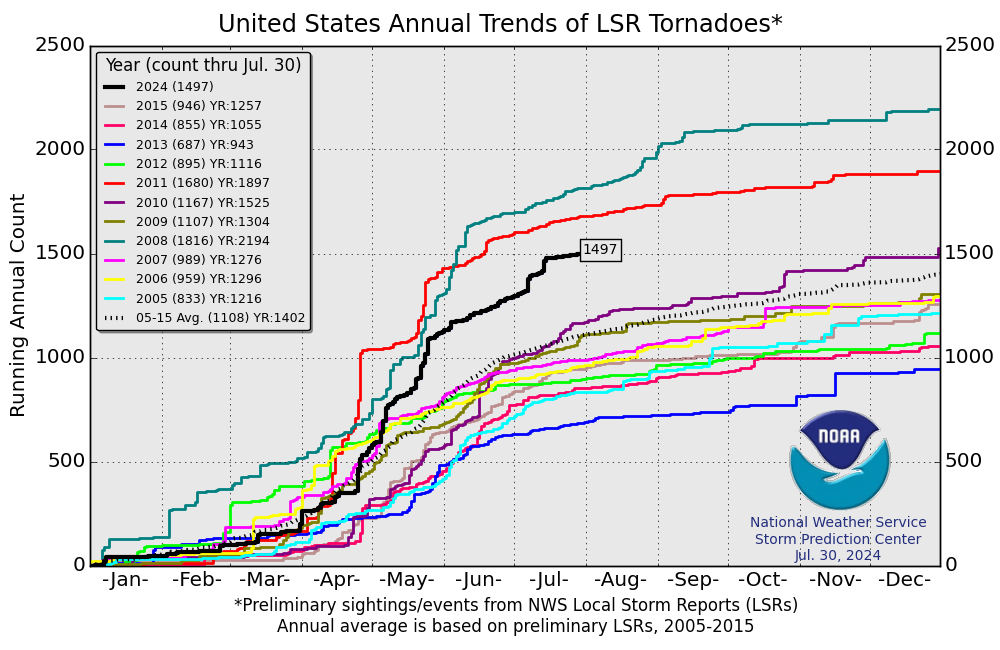
https://www.spc.noaa.gov/wcm/#data
from Climate Change Skeptic Blogs via hj on Inoreader http://bit.ly/2GRqCSy
Top 12 Debunked Climate Scares of 2018

from Climate Change Skeptic Blogs via hj on Inoreader http://bit.ly/2RlNP3p
Government Shutdown Delays UAH Global Temperature Update
The NOAA CLASS system we obtain our satellite orbit files (raw data) from has been taken offline until the government shutdown ends. As a result, our UAH monthly global temperature update is delayed.
from Climate Change Skeptic Blogs via hj on Inoreader http://bit.ly/2F0z1RM
Register Your Predictions For 2019!
As has been our tradition these many years, it's time to register our predictions for the coming year. We look at how well we did last year tomorrow.
Rules:
- Number your predictions, using numbers, like this.
- Limit your predictions to 5, a number less than 6 or more.
- No sports. Since it became woke and fully corperatized, it's boring. Have you ever heard sportsball talk on the radio? I'd rather listen to a Nancy Pelosi speech.
- Be specific and provide a way to verify your projections.
- Not only be specific, but feel free to attach a probability word (numbers are next to useless for scenarios/forecasts/predictions of our kind).
- Verified predictions of our coming Doom will receive very little weight, because we all understand that the end of the year will be worse than the beginning, and likely much worse: motus in fine velocior. Verified predictions of precise Doom receive high weight. Example: Donald Trump announces he will undergo sex "reassignment" surgery—and then he does it.
My attempts last year stank. But error does not slow me down. Here are my forecasts, numbered using numbers, and using numbers less than 6. I may add to these throughout the week as my intelligence and perspicacity grows.
My guesses:
- Trump will survive an assassination attempt. I think this has low probability (given many unarticulated reasons) for 2019, but modest for 2020. It edges past 50-50 if he institutes any policy perceived as against sexual deviancy or in forswearing all foreign entanglements.
- We will see among the evil chattering class at least seven strokes, a good dozen heart attacks, a burst spleen or two, and maybe even a suicide after the notorious RBG at last arrives at her fiery final destination and it is realized Trump gets to name another SCOTUS nominee. (Not, sadly, that the first two were in any way reactionary.)
- We will see a noticeable surge in dietary advice, recommendations, arguments, media harassment and government propaganda about "healthy" plant-based diets. Take this move by Panera Bread, a company that makes a good profit from same. More ominously, animals will begin to have legal "rights", a metaphysical impossibility. Well, so is same-sex "marriage", "transexuals", atheism, etc., so impossible is no limitation.
Hurry! Hurry! Hurry! Enter your sagacious foresights now! Send this post to friends who are always bragging about how great they are at knowing what is to come. Time to put up or keep quiet.
from Climate Change Skeptic Blogs via hj on Inoreader http://bit.ly/2AocESG
Tornadoes have not co-operated with climate alarmists in 2018

Kansas tornado [image credit: Wikipedia]
Of course 2019 may be different, but claims of a trend towards more severe weather due to human activity fall flat when the evidence fails to point in the predicted direction.
H/T The Global Warming Policy Forum (GWPF)
2018 [has] become the first year since formal record keeping began in 1950, in which the United States has not endured even one "violent" tornado.
Violent tornadoes are classified on the Enhanced Fujita Scale as being EF4 (winds of 166-200 mph) or EF5 (winds 200 mph).
The previous low number of violent tornadoes reported was in 2005, with only one.
The strongest tornado reported in all of North America this year was an EF4, which touched down in Manitoba in August. Only 12 EF3 tornadoes (136-165 mph) have touched down in the United States this year, also a record low.
. . .
Fatalities from tornadoes in the United States are at an all-time low this year as well, with only 10 deaths reported. In an average year, tornadoes kill 69 Americans. The deadliest year for tornadoes was reportedly 1925, when the Tri-State Tornado alone killed 695 people in Missouri, Illinois, and Indiana.
The reasons for the lack of tornadoes this year are not completely known; however, "one key factor is high pressure tending to be more dominant than normal throughout peak season this past spring," noted Ian Livingstone, a forecaster for Capital Weather Gang. High pressure systems generally tend to lead to blue skies and fewer clouds and storms.
"This was particularly so during April and May when tornado numbers were below to well below normal," Livingstone added.
But with climate change, aren't we supposed to see more violent and extreme weather?
Continued here.
from Climate Change Skeptic Blogs via hj on Inoreader http://bit.ly/2EZ9ys4
هفت باور نادرست درباره سرقت علمی - نیتیو پیپر
مانند سایر موضوعات، بدفهمیها و باورهای نادرست زیادی درباره سرقت علمی وجود دارد. با نادیده گرفتن قانون حق تألیف که بهروشنی مجازاتهای سرقت علمی را تبیین کرده است، بسیاری از پژوهشگران خود را بهطور جدی دچار دردسر میکنند. علیرغم آگاهی از نادرست بودن باورهای زیر، بسیاری از افراد آنها را توجیهی برای سرقتهای علمی میدانند. سرقت علمی از جمله پدیدههایی است که مردم دوست ندارند در کلاس درس یا محل کار دربارهاش صحبت کنند. در اینجا، هفت باور نادرست درباره سرقت علمی مرور میشوند، پس با نیتیو پیپر همراه باشید.
هفت باور نادرست درباره سرقت علمی
۱- تنها محتوایی که مالکیت خصوصی دارد را نمیتوان سرقت کرد
سرقت علمی و کپیرایت در این زمینه وجه اشتراک دارند. برخی فکر میکنند اگر اثری تحت مالکیت عمومی بوده یا مدت زمان مشخصی از انتشارش گذشته باشد، نیازی نیست به نام صاحب اثر اشاره کنند. هرچند در این حالت حق تألیف را نقض نکردهاید، با این حال، حتی اگر نویسنده اثر سالها پیش فوت کرده باشد یا اثر تحت مالکیت عمومی باشد، باز هم باید به نام وی اشاره کنید؛ در غیر این صورت، مرتکب سرقت علمی شدهاید.
۲- تنها باید نقل قولهای مستقیم را ارجاعدهی کرد
بسیاری از دانشجویان تنبل که از ارجاع دادن بیزارند همیشه در اینجا قربانی میشوند. آنها فکر میکنند تنها باید نقل قول مستقیم را ارجاعدهی کنند. بنابراین، با پارافریز کردن کل اثر از نقل قول مستقیم فرار میکنند. اما واقعیت این است که کلمات ابزارهای انتقال دادن، قرض گرفتن و اشتراکگذاری ایدهها و افکارند. ارجاع دادن کمک میکند سایر افراد محل دقیق منبع شما را پیدا کنند. بنابراین، حتی اگر کار را پارافریز کنید و به منبعتان ارجاع ندهید، مرتکب سرقت علمی شدهاید.
۳- سرقت علمی تصادفی اهمیتی ندارد
حتی پس از پارافریز کردن، شباهتهایی که با متن اصلی وجود دارد قابل ردگیریاند. حتی اگر برای پارافریز کردن تلاش زیادی انجام دهید، باز هم سرقت علمی صورت گرفته است. برخی اوقات، مشابهت یابهای آنلاین مواردی از شباهت را ردیابی میکنند که باعث شگفتی شما میشود. ممکن است به علت ثبت نکردن منابع پژوهشی از ابتدای نوشتن مقاله، آنها را گم کرده باشید. اینجا جایی است که ادعای بیگناهی میکنید. ممکن است از سرقت علمی اجتناب کرده باشید، اما واقعیت این است مرتکب خلاف شدهاید و ممکن است جریمهای سنگین در انتظارتان باشد. سرقت علمی تصادفی یا غیرتصادفی مهم نیست؛ مقاله همچنان سرقتی است.
۴- اینترنت یعنی دانش مشترک
بسیاری از دانشجویان گمان میکنند که چون اینترنت رایگان و دسترسی به آن برای همه آزاد است جزئی از دانش عمومی به حساب میآید و نیازی نیست اطلاعات استخراج شده از آن را ارجاعدهی کنند. دانش مشترک تعریف خاص خود را دارد. دانش مشترک یعنی اطلاعات و حقایقی که برای همه آشناست و در تمام کتابهای مرجع در دسترس عموم است و بهراحتی میتوان آن را بازیابی کرد. بنابراین، باید تمام منابع اطلاعاتی اینترنتی را ارجاعدهی کرد.
۵- سرقت علمی از خود مهم نیست
بسیاری از دانشجویان عادت کردهاند که مقاله خود را بازنویسی و در ژورنالهای متعدد سابمیت کنند. این کار نوعی سرقت علمی آکادمیک است. بسیاری از افراد این ادعا را که چیزی از دیگران سرقت نشده است قبول ندارند. کپیبرداری از کارهای خودتان و بازنویسی کردنشان ممکن است دردسرساز شود. بیشتر نویسندگان از فرصت سوء استفاده میکنند و از کارهایشان مجدداً استفاده میکنند. به همین دلیل، بسیاری از نشریات قانونهایی دارند که مانع از استفاده مجدد از آثار پیشین میشوند، مگر آنکه به روشنی به آنها ارجاعدهی شده باشد.
+بیشتر بخوانید: سرقت علمی از خود یا self-plagiarism چیست و چرا باید از آن اجتناب کرد؟
۶- هم میتوانم از ارجاعدهی درونمتنی استفاده کنم و هم از کتابشناسی
بسیاری از دانشجویان فکر میکنند میتوانند یکی از این دو شیوه را به کار ببرند. واقعیت این است که ژورنالها هم ارجاع درونمتنی و هم کتابشناسی را الزامی میدانند. ارجاعات درونمتنی نشان میدهند که محتوای قرض گرفته شده کجا آغاز میشود و کجا پایان مییابد. کتابشناسی به مخاطب نشان میدهد که چگونه میتوانند به منابع استفاده شده دسترسی پیدا کنند.
۷- سرقت علمی تنها در کشورهای غیرانگلیسیزبان رایج است
موانع زبانی تا حدی در این مسئله نقش داشته است. این باور تا حدی درست است. پژوهشگرانی که کارهایشان را به انگلیسی آماده میکنند با مسائل متعددی مواجه میشوند که آنها را در معرض سرقت علمی قرار میدهد. ممکن است به دلیل کمبود اعتماد به نفس مرتکب این عمل شوند. با این حال، واقعیت این است که سرقت علمی مسئلهای جهانی است، و هم در کشورهای انگلیسی زبان اتفاق میافتد و هم در کشورهای غیرانگلیسی زبان.
سرقت علمی مجازات دارد. مهم نیست در کجا اتفاق افتاده است. بنابراین، پیشنهاد میشود از استادان دانشگاه کمک گرفته شود. مطمئن شوید که باورهای درست و نادرست درباره سرقت علمی و مجازاتهای آن را مطابق با قانون حق تالیف درک کردهاید. ویراستاران باید پژوهشگران را توجیه کنند که سرقت علمی چه تاثیر نامطلوبی بر صاحبان اصلی آثار دارد.
Subscribe to:
Posts (Atom)
-
Chem. Commun. , 2019, Accepted Manuscript DOI : 10.1039/C8CC10001B, Communication Ning Dong, Hao Luo, Yonggao Xia, Haocheng Guo, Rushe...
-
Hi there How would you like to earn a 35% commission for each sale for life by selling SEO services Every website owner requires the ...