Tuesday, February 12, 2019
Nuclear Power and Pennsylvania's Competition Act
from Climate Change Skeptic Blogs via hj on Inoreader https://on.nrdc.org/2tloFUV

[ASAP] Tunable Valley Polarized Plasmon-Exciton Polaritons in Two-Dimensional Semiconductors

ACS Nano
DOI: 10.1021/acsnano.8b06775


from Journals via hj on Inoreader http://bit.ly/2TLCxDz
[ASAP] Machine-Learning-Driven Surface-Enhanced Raman Scattering Optophysiology Reveals Multiplexed Metabolite Gradients Near Cells

ACS Nano
DOI: 10.1021/acsnano.8b07024

from Journals via hj on Inoreader http://bit.ly/2Bwzgk8
[ASAP] Spatially Resolved Chemical Detection with a Nanoneedle-Probe-Supported Biological Nanopore

ACS Nano
DOI: 10.1021/acsnano.8b09667

from Journals via hj on Inoreader http://bit.ly/2TLdD6X
[ASAP] Multifunctional Copper(I) Coordination Polymers with Aromatic Mono- and Ditopic Thioamides

Inorganic Chemistry
DOI: 10.1021/acs.inorgchem.8b03364


from Journals via hj on Inoreader http://bit.ly/2BIpOdV
Phytoremediatory efficiency of Chrysopogon zizanioides in the treatment of landfill leachate: a case study
Abstract
A common approach for waste management is their disposal in landfills, which is usually associated with the production of dangerous gases and of liquid leachate. Due to its toxicity, polluted liquid negatively impacts on the environment with the possible contamination of large volumes of soil, groundwater, and surface water. Leachate remediation is therefore subject of intensive research, and phytoremediation has been achieving increasing interest in recent decades. We describe here the suitability of vetiver grass for the remediation of two leachates collected in urban landfills of northern Italy, characterized by different composition. Our objective was measuring the accumulation/tolerance potential of this species and the evapotranspiration ability in a pot experiment, to evaluate applicability of vetiver plants for the reduction and decontamination of landfill leachate. Plants were grown for 4 months in pots with a zeolite growth bed and watered with either tap water (control) or undiluted landfill leachate. Plant growth and fitness and elemental content in shoots and roots were evaluated at the end of the experiment. In these experimental conditions, the high bioaccumulation of metals highlights the suitability of this species for its employment in phytoremediation; however, vetiver growth under leachate treatment was strongly dependent on leachate composition, making a case-to-case evaluation of plant tolerance necessary before large-scale application.
from Climate Change Skeptic Blogs via hj on Inoreader http://bit.ly/2RY7Zwm
Australia’s new hottest day just “discovered”, not Albany or Oodnadatta, but Carnarvon (51 degrees in 1953!)
…
Who knew? With intrepid dedication the Australian BoM has uncovered our hottest ever day, buried until now, under erroneous calculations, hidden from view in High Quality expert data sets that were World Class til they weren't. Strangely the BOM hasn't issued a press release, even though their supercomputer-marketing team put out a Hottest Ever January media release within hours of January ending. Indeed the BOM hasn't even issued a press release to tell the world they've done the third complete reanalysis of Australian temperature history.
Luckily for the BOM, which may have run out of bytes or letters of the alphabet, volunteers like Chris Gillham of the unofficial BoM audit team noticed that the BoM ACORN dataset has become ACORN2. So we'd like to tell the world. Once again, the genius at the BOM is able to retrospectively compensate for all the flawed sites and thermometers that kept reading too high. Incredibly, no one noticed for a hundred years.
As we launch ACORN2 let's remember how proud the BOM were of ACORN1. This is from them back in 2017:
Bureau of Meteorology statement on temperature observations01/08/2017
The Bureau of Meteorology holds the integrity [...]

Rating: 0.0/10 (0 votes cast)
from Climate Change Skeptic Blogs via hj on Inoreader http://bit.ly/2StbOz4
New research finds possible second impact crater hiding under Greenland ice
WASHINGTON — Scientists have discovered a possible second impact crater buried under more than a mile of ice in northwest Greenland. This follows the finding, announced in November 2018, of a 19-mile-wide crater beneath Hiawatha Glacier – the first meteorite impact crater ever discovered under Earth's ice sheets. Though the newly found impact sites in…
from Climate Change Skeptic Blogs via hj on Inoreader http://bit.ly/2DB0giI
from Climate Change Skeptic Blogs via hj on Inoreader http://bit.ly/2DB0giI
Government (-driven) shutdowns have human consequences
Too many government regulators burden and shut down private sector businesses and jobs Paul Driessen Many observers praised President Trump's 2019 State of the Union speech. Some said it was his best ever and even as one of the best SOTU speeches in history. It celebrated the nation's progress, extolled its opportunities and sought bipartisan…
from Climate Change Skeptic Blogs via hj on Inoreader http://bit.ly/2SsYhHr
Newsweek features Morano – Mag. agrees with Morano’s claims on UN Paris pact! FOX NEWS GUEST MORANO SAYS ADDRESSING CLIMATE THROUGH PARIS AGREEMENT ARE ‘MEDIEVAL WITCHCRAFT’
Watch Full Fox & Friends Segment here: Morano point #1 on Fox & Friends Feb. 12, 2019: "The authors of this two degree target actually admit it was, quote, pulled from thin air, the scientists in the United Nations admit this." See: Book reveals UN's goal of '2 degree' limit of 'global warming' has no scientific [...]
from Climate Change Skeptic Blogs via hj on Inoreader http://bit.ly/2GmXwt4
Comprehensive Study: Glacier Melt Estimates In Tropics Of South America OVERSTATED BY 10 TIMES!
Geographers from FAU investigating glaciers in South America in more detail than ever
If you compare historical photos of glaciers with those taken more recently, you can see that where there was formerly ice there is now very often nothing but rock. Geographers, however, are less interested in the area covered by a glacier, and more interested in its mass. Researchers from FAU have now investigated all glacial areas in South America in more detail than ever before, from the tropical areas of Venezuela to the subpolar regions of Tierra del Fuego.
Their two major findings are that the highest rate of mass loss is in the Patagonian ice sheet, and that the glaciers in the tropics have lost considerably less mass than previously projected, although this is not the good news which it might appear at first sight. The researchers' findings have been published in the journal Nature Climate Change.*
Surveying glaciers is nothing new. There are two methods which are used particularly often. In the first method, researchers take several measurements directly at a glacier and project the results for entire regions. This is particularly problematic when it comes to large glacial areas such as the large ice fields in Patagonia, as barely any in situ measurements are available for these areas.
The other option is to take gravimetric measurements using satellites. Scientists base their measurements on the fact that gravity on Earth changes depending not only on the location but also over time. It is influenced by aspects such as the composition of the Earth's surface, mountain ranges, movements in the core, plate movements – and, of interest for our context, when glaciers lose mass. One disadvantage of this method is that when only small areas are covered by glaciers, as is the case in the South American tropics, the satellite only receives a weak signal and the measurement is significantly less accurate.
One method for measuring all glaciers
Geographers from FAU specialising in both climatology and remote sensing and spatial information, led by Prof. Dr. Matthias Braun and Dr. Tobias Sauter, also used satellite data for surveying South American glaciers, but they focused on calculating elevation levels instead of basing their results on gravimetric measurements. Two radar satellites from the German Aerospace Center (DLR) have been orbiting the Earth since 2010. The aim of the TanDEM-X-mission was to obtain a three dimensional image of the Earth, which is not only of a consistent quality but also more accurate than anything that has gone before.
Differences in elevation were recorded down to the last metre. The researchers from FAU used data collected between 2011 and 2015 and compared them with measurements from the Shuttle Radar Topography Mission of 2000. Using a complex method which involved making various corrections and calculating possible error margins, they compared the data to calculate the changes in elevation in the glacial regions of South America, thus obtaining an accurate picture of the changes in glacial mass.
Their method was unusual in that they were able to use one uniform method to record all glacial areas in the region. In addition, the method even provided accurate data for individual glaciers. Comparing the measurements from both space missions allowed the researchers to gain detailed insights into the situation throughout South America. For the first time, researchers succeeded in analysing the large Patagonian ice fields separately from the surrounding, smaller glaciers.
Entire glaciers have vanished
The greatest loss of mass, both relatively and in comparison to the other South American glaciers, was found in both inland ice fields in Patagonia, two regions with an area of approximately 18,000 square kilometres, roughly equivalent to the Rhineland-Palatinate region in Germany.
Slower rate of mass loss in tropics
The second important fact revealed by the research is that the mass of glaciers in the tropical regions of South America – in Venezuela, Columbia, Ecuador, Peru and Bolivia – is changing at a considerably slower rate than previously supposed. Projections to date calculated that the 2900 glaciers there were losing approximately 6 gigatonnes of mass per year. The geographers from FAU have discovered, however, that they are only losing 0.55 gigatonnes per year, approximately 10 percent of the estimates to date.
This result is important, as glaciers are an important source of water in the dry period: when no rain falls and the temperatures reach their highest level, glacier melt water is used as drinking water, for irrigation and hydro power. People in these regions therefore have to know to what extent the glaciers are changing, and need quantitative data not only with respect to area but also in terms of their volume and mass.
In some areas such as the Central Andes in Chile and Argentina or the Cordillera Real in Bolivia, experts are even of the opinion that the maximum amount of water available from glacial melt has already been exceeded. This is an indication that glaciers are irrevocably on the retreat and will vanish entirely in the foreseeable future. In future, these areas will have less water available during the dry season.
The survey, however, also revealed that some areas have hardly experienced any change at all, such as the Andes in northern Chile and Argentina as well as in southern Bolivia at the latitude of the Atacama desert.
The researchers from Erlangen now hope that their study will be included in the next report of the Intergovernmental Panel on Climate Change (IPCC). After all, melted glacier ice is contributing to the rise in sea levels and the huge ice fields in Patagonia are particularly relevant. Glaciers are also used as an indicator for climate change in other respects as well.
The geographers from FAU now want to extend their analyses to cover other regions and investigate how the situation develops over a longer period of time. At present, the global terrain model from the TanDEM-X mission is currently being updated. Researchers hope to be able to benefit from these data in future. They are also relying on further national missions which are in the pipeline such as the Tandem-L satellites, which would make it possible for such measurements to be repeated more frequently.
* https://doi.org/10.1038/s41558-018-0375-7
Further information:
Prof. Dr. Matthias Braun
Phone + 49 9131 85-22015
matthias.h.braun@fau.de
=========================================================
Hat-tip: Die kalte Sonne.
from Climate Change Skeptic Blogs via hj on Inoreader http://bit.ly/2DyctVz
A Big Step Forward in Debate Over LA’s Clean Energy Future

from Climate Change Skeptic Blogs via hj on Inoreader https://on.nrdc.org/2USsexx
GHCN v3.3 Regions Closeup Current vs Baseline
Regional close up maps for each continent showing the thermometer locations kept in use vs those in the Baseline (1950-1980 roughly) that have been dropped. Continue reading →
from Climate Change Skeptic Blogs via hj on Inoreader http://bit.ly/2N2T6rX
Green New Deal Would Kill Almost Everyone, Warns Greenpeace Co-Founder
Green New Deal Would Kill Almost Everyone, Warns Greenpeace Co-Founder

CALGARY, Canada - The "Green New Deal" proposed by congressional Democrats is a "recipe for mass suicide" and the "most ridiculous scenario I ever heard," Greenpeace Co-Founder Patrick Moore (shown) warned in an exclusive interview with The New American. In fact, Dr. Moore warned that if the "completely preposterous" prescriptions in the scheme were actually implemented, Americans could be forced to turn to cannibalism to avoid starvation - and they still would not survive. Other experts such as Craig Rucker, the executive director of the environmental group Committee for a Constructive Tomorrow (CFACT), also sounded the alarm about the "green" proposal in Congress, comparing it to Soviet five-year plans and calling it a "prescription for disaster."
The so-called Green New Deal is a massive scheme to, among other goals, restructure the U.S. economy. It is being advanced by a coalition of radical communist and socialist Democrats in Congress led by U.S. Representative Alexandria Ocasio-Cortez (D-N.Y.). A resolution (H. Res. 109) "recognizing the duty of the Federal Government to create a Green New Deal (GND)" already has 67 co-sponsors in the House. If the scheme outlined in the resolution expressing the "sense of the House" is implemented, it would seek to eliminate air travel, the eating of steaks, the use of hydrocarbons, and more. It would aim to completely end all emissions of CO2 - an essential gas exhaled by every living person and required by plants - over the coming decade.
Moore, who was one of six international directors of Greenpeace, was flabbergasted that something so ludicrous could even be proposed, much less be advanced in the U.S. government. "It is quite amazing that someone that is in government - actually elected to the government of the United States of America - would propose that we eliminate all fossil fuels in 12 years," he said in an on-camera interview with The New American from Canada. "This would basically result, if we did it on a global level, it would result in the decimation of the human population from 7-odd billion down to who knows how few people." It would end up killing almost everyone on the planet, he added.
Worse than mass death would be the way people reacted. "It would basically begin a process of cannibalization among the human species, because the food could not be delivered to the stores in the middle of the cities anymore," Moore continued. "The point that bothers me the most is that if you eliminated fossil fuels, every tree in the world would be cut for fuel. There is no other source for heating and cooking once you eliminate fossil fuels. You could use animal dung, if there were any animals left, but the animals would all die too because they would all get eaten."
Moore also slammed the "social aspects" of the Green New Deal proposals such as "paying people who are unwilling to work," according to a FAQ released by Ocasio-Cortez' office. "I can't believe that anyone would write that in a proposal for law in the United States of America," he said, calling it "just unbelievable." Indeed, that language and other half-baked ideas caused nationwide ridicule of Ocasio-Cortez and others involved in pushing the "New Deal." The ridicule got so intense that one of its proponents eventually lied, claiming that mischievous Republicans might have put out a fake Green New Deal document to make Democrats look ridiculous. But then the truth came out, despite the FAQ being removed from Cortez's congressional website.
But the absurdity of it all may be a boost to Republicans and President Donald Trump. "We have a situation where something completely preposterous is being backed by a large number of Democratic congressional elected representatives in the United States of America," Moore said. "This is actually going to put Trump right over the top. I cannot see how this can possibly be negative for him. It can only be positive, because people recognize when something is preposterous. And I think that is the best word for it."
"The best term for it is actually mass-suicidal," Moore added. "Why would anyone vote for something that was going to result in the death of nearly all humans on Earth?" As far as what Americans could do who support the environment but not mass suicide, Moore urged people not to vote for anyone who would support the "Green New Deal."
Speaking at a conference put on by the Economic Education Association of Alberta over the weekend, Moore also explained that so much of what climate alarmists were pushing was pseudo-science and easily discredited lies. For instance, carbon dioxide is actually doing great things in terms of greening the planet - after all, it is plant food, Moore said. He also lambasted those who say coral reefs are dying due to alleged man-made global warming, something he said was not true. Noting that trucks need hydrocarbon fuels to bring produce to market in cities, Dr. Moore explained that just that one problem alone would be absolutely catastrophic if CO2 emissions were ended.
Moore has since left the Greenpeace he helped found, because it left him. When the group was founded, "we wanted to save civilization, we didn't want to destroy it," he told The New American. "By the time I left Greenpeace, it had drifted into a situation in which all they had left was the green. They kind of dropped the peace, which was the human side of the situation. And now they were characterizing people as the enemies of the Earth - the human species as the enemies of nature, as if we were the only evil species."
One of the most outrageous campaigns by Greenpeace, Moore said, was when the leadership - which had no formal science education - decided to try to ban chlorine use worldwide. "Yes, chlorine can be toxic, it was used as a weapon in World War I," he said. "But the fact that it is toxic is why it is the most important element in public health and medicine. Adding it to drinking water was the biggest advance in the history of public health… that has saved hundreds of millions of lives through the time that we learned to use chlorine as an anti-bacterial agent." Nature, he added, is full of toxic materials.
In his own keynote address at the conference, CFACT's Rucker - who famously boarded Greenpeace ships to "punk" them with propaganda banners reading "ship of lies" and "propaganda warrior" - explained that much of the environmentalist movement has it backwards. The real key to preserving the environment, he said, is free markets, private property, and prosperity. Poor nations do not have the resources to protect the environment. And socialist-ruled nations have the worst environmental track-records of all. Meanwhile, freer and wealthier nations such as the United States, Canada, Japan, and Western Europe have remarkably clean environments.
In an interview with The New American, Rucker celebrated freedom. "What's good for people is good for nature," he said, calling for pro-growth policies that benefit people rather than government- enforced scarcity. "It's like the old Chinese proverb: When there is food on the table, there are many problems; when there is no food on the table, there is one problem. Societies that do not take care of their people don't have the resources to take care of the planet."
Rucker, a top leader of the non-totalitarian environmental movement, also slammed the "Green New Deal" being advanced in Congress. "It is a horrible idea," he said, blasting the original New Deal as well. "But I actually think it is more like the Soviet 5-year plan… They want to be off fossil fuels within 10 years. That is insane. It is not that we are embracing fossil fuels, but this is a government-driven objective much like the old Soviet plans were government-driven objectives. It is going to fail. And the problem is, it is going to take a lot of people down with it… This is going to really hurt people. It is a prescription for disaster."
Citing University of Maryland business Professor Julian Simon, Rucker used a hilarious example to illustrate the point. If the ideology of the sustainable-development movement were used 100 years ago, there would be great concern about where humanity was going to get enough whale oil to use as lighting. But of course, since then, electricity and light bulbs have taken the place of whale oil, thereby eliminating the alleged prospect of resources running out. The same concept applies to other resources, too, he said. When the price goes up due to scarcity, people will find substitutes and new ways of getting what they need - at least they will if markets are allowed to operate. "People are not just mouths, they are also hands and a brain," he said.
He also drew a distinction between the "conservation" ethic, in which man is included in how to protect the planet, and the "preservation" ethic and the "Deep Green ecology" that views man as a "virus on the planet" that needs to be removed. Obviously, efforts to conserve nature should have the well-being of man in mind, he said.
Rucker and Moore both served at keynote speakers at the annual "FreedomTalk" conference Economic Education Association of Alberta. This writer gave a speech focusing on the indoctrination of children taking place in public schools - and particularly the implications of it for freedom. Other speakers highlighted the problems with the man-made global-warming hypothesis, the looming public pension disaster, and much more.
from Climate Change Skeptic Blogs via hj on Inoreader http://www.icecap.us/
If Saving The Climate Requires Making Energy So Expensive, Why Is French energy so cheap?
Michael Shellenberger, Forbes
Ask almost any economist and she'll tell you the same thing: if you want to save the planet from 'runaway climate change', you have to make energy expensive.
"Economics contains one fundamental truth about climate change policy," wrote Yale University economist William Nordhaus in 2008, who won the 2018 Nobel Prize for his work. "For any policy to be effective in solving global warming, it must raise the market price of carbon, which will raise the market prices of fossil fuels and the products of fossil fuels."
Various policies can be used to make electricity more expensive. For example, you can tax carbon emissions or put in place air pollution regulations.
However, the most popular way to make energy expensive is to do what Germany has done and that's to subsidize solar and wind energies through a surcharge (or tax) on electricity
But such efforts beg the question: why, if making energy expensive is required to reduce emissions, does France generate less than one-tenth the carbon emissions of Germany at nearly half the cost?
Germany vs. France
Few nations have done more to make energy expensive in the name of saving the climate than has Germany.
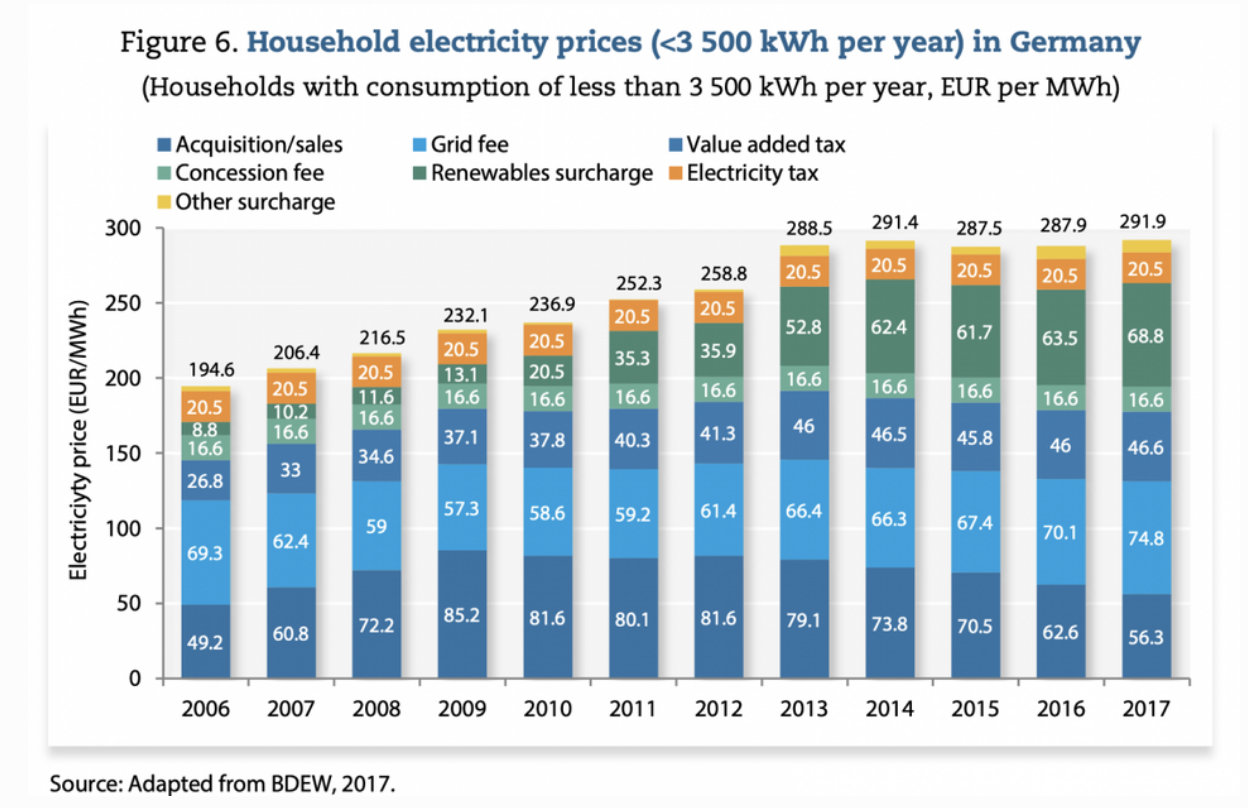
A new study by the Organization of Economic Cooperation and Development (OECD) shows how Germany, between 2006 and 2017, increased the cost of electricity for households by 50%.
Enlarged

The report, "The Costs of Decarbonization," documents how the German government made electricity expensive by requiring consumers to subsidize solar, wind and other forms of renewable energy.
Lower costs of solar panels and wind turbines haven't allowed Germans to spend less on renewable energy. In fact, they've had to spend more.OECD
This reality will surprise many journalists and other advocates of renewables who have noted how, over the exact same period, the cost of solar panels and wind turbines has declined dramatically.
It turns out that those lower costs haven't allowed Germans to spend less on renewable energy. In fact, they've had to spend more.
Because solar and wind are inherently unreliable and energy-dilute, Germany has had to spend 27% more on things like transmission lines from distant solar and wind farms spread all throughout the country.
Has expensive German electricity lowered carbon emissions? It hasn't. The country's carbon emissions have been flat since 2009. A big part of the reason has been due to the country's attempt to replace nuclear power plants with solar and wind energies.
In 2018, German carbon emissions declined modestly, but only because of unusually warm weather and - ironically - higher nuclear output (4.9%) which grew more than renewables did (3.1%).
Promoters of renewable energy subsidies claimed in 2015 that the cost of electricity would peak in 2023, but the new OECD report concludes that electricity prices will increase as long as Germany keeps deploying solar and wind - in other words, indefinitely.
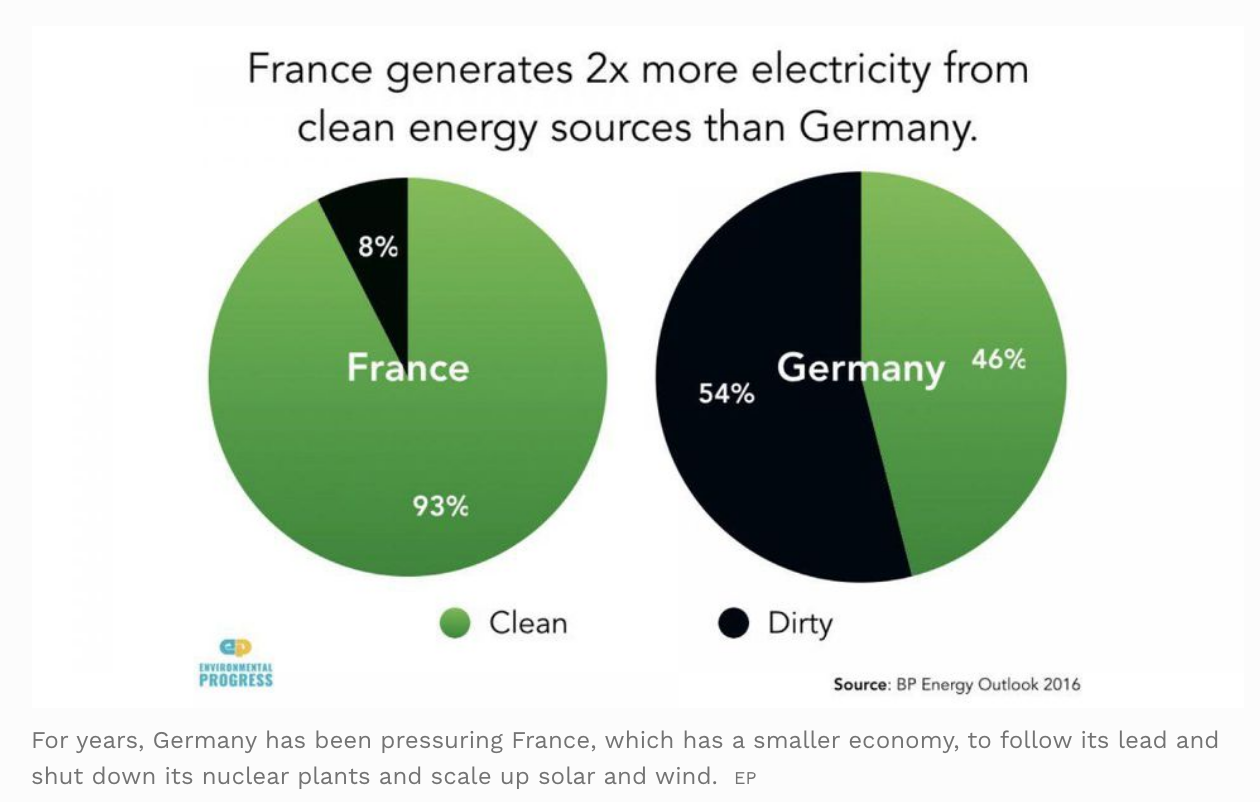
French electricity costs are just 59% of German electricity prices. As such, according to the prevailing economic wisdom, French electricity should be far more carbon intensive than German's. And yet the opposite is the case. France produces one-tenth the carbon pollution from electricity.
Why? Because France generates 72% of its electricity from nuclear, and just 6% from solar and wind.
For years, Germany has been pressuring France, which has a smaller economy, to follow its lead and shut down its nuclear plants and scale up solar and wind.EP
Will France Follow Germany?
For years, Germany has been pressuring France, which has a smaller economy, to follow its lead and shut down its nuclear plants and scale up solar and wind.
France has increasingly done what Germany wants. According to the Commision de Regulation de L'Energie, Euro29 billion (US$33) billion was used to purchase wind and solar electricity in mainland France between 2009 and 2018.
But the money spent on renewables did not lead to cleaner electricity, according to a new analysis by my Environmental Progress colleagues, Mark Nelson and Madison Czerwinski.
In fact, the carbon-intensity of French electricity has increased. After years of subsidies for solar and wind, France's 2017 emissions of 68g/CO2 per kWh was higher than any year between 2012 and 2016.
The reason? Record-breaking wind and solar production did not make up for falling nuclear energy output and higher natural gas consumption. And now, the high cost of renewable electricity is showing up in French household electricity bills.

German electricity is nearly 10 times more carbon-intensive than France's EP
According to Eurostat, although French households pay 41% less than German households, electricity in France has, over the past decade, been increasing in price much faster than electricity in Germany.
"French prices have increased 45% since 2009 as compared to 29% in Germany and 25% in the EU," note Nelson and Czerwinski.
This is a problem, they note, because "Expensive electricity acts as a disincentive to electrify transportation, heating, and cooking, which together constitute a larger share of energy, and carbon emissions, than electricity."
The two arrive at a shocking conclusion: "France could have completely decarbonized its electricity sector had it spent $32 billion on new nuclear plants rather than on renewables like solar and wind."
And were France to keep operating Fessenheim, a nuclear plant scheduled to be closed in 2020, start-up a new nuclear plant called Flamanville, build three more reactors the same size, and operate each nuclear plant an average of 85 percent of the year instead of its current average of 70 percent, it could generate sufficient zero-carbon electricity to completely decarbonize its road transportation sector.
But France appears unwilling to do that. Instead, France's president, Emmanuel Macron, announced recently that he will stick with plans to reduce the nation's usage of its nuclear plants, increase its output of renewables, and thus - necessarily - increase energy prices.
As such, Macron appears to have learned little from last year's Yellow Vests protests, which were triggered after he did what economists and Germans alike have long insisted he must do in order to address climate change: raise gasoline and diesel prices by taxing carbon emissions.
Michael Shellenberger, President, Environmental Progress. Time Magazine "Hero of the Environment."
from Climate Change Skeptic Blogs via hj on Inoreader http://www.icecap.us/
TRUMP MOCKS GREEN NEW DEAL: ‘HIGH SCHOOL TERM PAPER’ – ‘HOW DO YOU TAKE A TRAIN TO EUROPE?’
http://bit.ly/2Srkgi8 By Tom Elliott 1.00 Play Video TRANSCRIPT: TRUMP: "Last week, the massive government takeover, it would destroy our incredible economic gains. They introduced the so-called Green New Deal." [Booing] TRUMP: "It sounds like he high school term paper that got back a low mark. It was shut down American energy, I think the people [...]
from Climate Change Skeptic Blogs via hj on Inoreader http://bit.ly/2TMwIWj
Green New Deal: A Democratic suicide note – Pat Buchanan says AOC’s plan ‘reads like it was written by the college socialists club’
http://bit.ly/2DxAqfo By Patrick Buchanan After reading an especially radical platform agreed upon by the British Labor Party, one Tory wag described it as "the longest suicide note in history." The phrase comes to mind on reading of the resolution calling for a Green New Deal, advanced by Rep. Alexandria Ocasio-Cortez, and endorsed by at [...]
from Climate Change Skeptic Blogs via hj on Inoreader http://bit.ly/2BuX08s
Reuters: Labor unions fear Democrats’ Green New Deal poses job threat – Fear ‘job losses that will surely come’
https://reut.rs/2BBnhSx By Valerie Volcovici WASHINGTON (Reuters) – Labor unions say they are withholding support for a Green New Deal unveiled by Democrats last week to transition the American economy away from fossil fuels, arguing the loosely-defined plan could kill jobs if its architects aren't careful. The cool response from unions underscores the challenge facing Democratic [...]
from Climate Change Skeptic Blogs via hj on Inoreader http://bit.ly/2TLiNjr
[ASAP] Hierarchical Ni2P@NiFeAlO Nanosheet Arrays as Bifunctional Catalysts for Superior Overall Water Splitting

Inorganic Chemistry
DOI: 10.1021/acs.inorgchem.8b03327

from Journals via hj on Inoreader http://bit.ly/2TN2ume
[ASAP] Determination of Energy-Level Alignment in Molecular Tunnel Junctions by Transport and Spectroscopy: Self-Consistency for the Case of Oligophenylene Thiols and Dithiols on Ag, Au, and Pt Electrodes

Journal of the American Chemical Society
DOI: 10.1021/jacs.8b13370


from Journals via hj on Inoreader http://bit.ly/2TK0Bq9
Subscribe to:
Posts (Atom)
-
Chem. Commun. , 2019, Accepted Manuscript DOI : 10.1039/C8CC10001B, Communication Ning Dong, Hao Luo, Yonggao Xia, Haocheng Guo, Rushe...
-
Hi there How would you like to earn a 35% commission for each sale for life by selling SEO services Every website owner requires the ...