ACS Nano
DOI: 10.1021/acsnano.8b07996


from Journals via hj on Inoreader http://bit.ly/2FU66hR


By Paul Homewood
Today's climate scare comes from the BBC:

A keystone prey species in the Southern Ocean is retreating towards the Antarctic because of climate change.
Krill are small, shrimp-like creatures that swarm in vast numbers and form a major part of the diets of whales, penguins, seabirds, seals and fish.
Scientists say warming conditions in recent decades have led to the krill contracting poleward.
If the shift is maintained, it will have negative ecosystem impacts, they warn.
Already there is some evidence that macaroni penguins and fur seals may be finding it harder to get enough of the krill to support their populations.
"Our results suggest that over the past 40 years, the amount of krill has, on average, gone down, and also the location of the krill has contracted to much less of the habitat. That suggests all these other animals that eat krill will face much more intense competition with each other for this important food resource," Simeon Hill from the British Antarctic Survey told BBC News.
It focuses on the Scotia Sea and the Antarctic Peninsula – the places where the crustaceans are most abundant.
Scientists have been gathering data in these areas since the 1920s.
Initially, krill catches were recorded to understand the environmental consequences of commercial whaling, but the information has continued to be collected through to the present.
Dr Hill and colleagues say the change in the distribution and density of the crustaceans is a clear signal that emerges in the data from the late 1980s onwards.
It coincides with a phase change in a climate oscillation known as the Southern Annular Mode.
The SAM essentially describes the dominant pattern of pressure zones in the southern hemisphere outside of the tropics.
The mode's switch in state in the late 80s produced warmer, cloudier, windier weather, and much less sea-ice in those areas where the krill had tended to congregate.
https://www.bbc.co.uk/news/science-environment-46953652
Note to the BBC – the Southern Annular Mode (SAM) has nothing whatsoever to do with climate change. Instead it is simply a natural climatic cycle, just as the PDO or AMO are.
New Zealand's Environmental Reporting Series shows how the SAM has oscillated since the 1800s:

The population of krill has been affected by other factors over the decades.
When commercial whaling was large scale in the early years of the 20thC, the population of krill would naturally have thrived.
Just at the time when whaling was ending, fishing for krill took off. According to this 2014 paper:
Fishing is the major industry in Antarctic waters. Hundreds of thousands of tons are landed each year. Antarctic krill (E. superba) support the largest fishery (Figures 5 and 6). In the 1970s, development of the commercial krill fishery was facilitated by heavy fishing subsidies in the USSR, which became the most important krill-fishing nation during the 1970s and the 1980s (Nicol and Foster, 2003).
https://academic.oup.com/icesjms/article/71/7/1934/666832
FAOSTAT show how the harvest of Antarctic krill grew from a figure of 4t in 1961 to over 500,000t. Even though harvest dropped back in the 1990s, the damage had already been done.

http://www.fao.org/fishery/species/3393/en
Most of the fishing takes place in the Scotia Sea, which this new study has identified as the main area of decline.


According to the BBC article:
Margaret McBride, from the Norwegian Institute of Marine Research in Bergen, has written a comment article on the research in the same edition of Nature Climate Change.
She said models had predicted that krill would shift southwards in the future, whereas the new research suggested this contraction was already under way.
"It offers a profoundly adverse, but highly plausible, endgame for Antarctic krill that has serious implications for both the Southern Ocean food web and sustainable management of fisheries targeting this species," she wrote
However, although the actual study makes vague warnings about what a warmer climate might bring in future, it provides no evidence that global warming has had any effect on the current situation.
Indeed, on the contrary Southern Ocean SSTs have been dropping since 1980, and currently are below the long term mean.

https://bobtisdale.wordpress.com/2016/11/08/october-2016-sea-surface-temperature-sst-anomaly-update/

It has also been claimed that krill are at risk from winter sea ice recedes. But as we know, winter sea ice extent has been gradually rising since 1979:


https://nsidc.org/data/seaice_index/bist
There is no evidence in this study to show that the population or distribution of Antarctic krill has been affected by global warming, or will be in future.
Danish Professor Henrik Svensmark is a leading physicist of cosmic radiation. At the end of last year he made a presentation at the 12th International Climate Conference in Munich, where he demonstrated that the climate is indeed modulated in large part by cloud cover, which in turn is modulated by solar activity in combination with cosmic rays.
His theory is that cosmic rays, which are extremely fast-flying particles – which originate from dying supernovae – travel through the cosmos, strike the Earth's atmosphere and have a major impact on cloud cover and thus climate on the Earth's surface.
This, Svensmark says, has been confirmed in numerous laboratory experiments.
Video source: EIKE.
In his presentation, the renowned Danish scientist showed how solar activity modulates the cosmic rays striking the atmosphere, and thus the climate-impacting cloud cover. Dr. Svensmark shows that there are powerful correlations worldwide between solar activity and climatic cycles, and so the sun is clearly playing a role in combination with the cosmic cloud-seeding rays. Hundreds of studies confirm this.
Observations and proxy data show that "when you have high cosmic rays, you have a cold climate" because of greater cloud cover. According Svensmark, the net effect of clouds is to cool the Earth by up to 30 W/m2.
Clouds are extremely important for the Earth's energy budget. The net effect is about 20 to 30 watts per square meter."
That figure is great in terms of impact on climate change, and it is grossly neglected by CO2-fixated climate scientists.
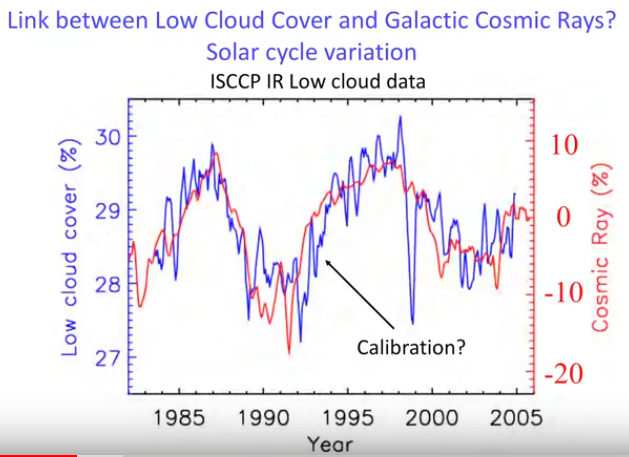
His research shows there is clear link between low cloud cover formation and galactic cosmic rays:
Sun modulates the cosmic ray intensity hitting the Earth's atmosphere
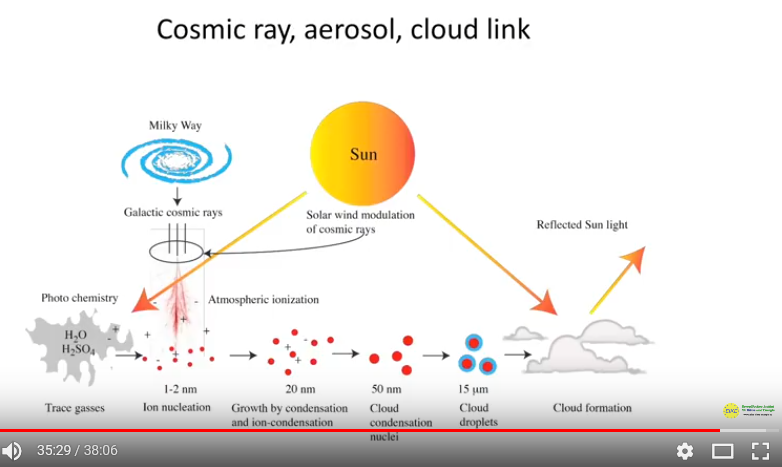
In his presentation (see video) he explains the mechanism of how the cosmic rays seed low level clouds, which act to cool the climate. In periods of intense solar activity, the sun's magnetic field engulfs and shields the Earth's atmosphere from the cloud-seeding cosmic rays, thus less low level clouds are formed and the Earth warms.
Vice versa, i.e. during periods of low solar activity, the sun's magnetic field is weaker, and so more cosmic rays are able to penetrate into the atmosphere and seed clouds. The resulting clouds act to cool the planet.
Confirmed by experiments
Svensmark's experiments confirm that solar cycles impact energy changes in the oceans by an order of 1.5 W/m2 over an 11-year cycle and that his findings are consistent with climate changes over the Holocene and even geological times going back more than 100 million years.
Over geological history, especially when the Earth traveled through one of the spiral arms of the Milky Way, cosmic rays striking the atmosphere were very intense and thus led to extremely cold conditions known as the Snowball Earth episodes. Other scientists insist the episodes were caused by intense volcanic eruptions.
Significant solar changes in Earth's energy budget
Dr. Svensmark summarizes the solar activity/cosmic ray climate modulation system with the following chart:
In the end, changes in solar activity lead to significant changes in the earth's energy budget, and thus climate change, Svensmark believes. This explains why the Earth has seen "coolings and warmings of around 2°C repeatedly over the past 10,000 years."
He concludes:
The Sun became unusually active during the 20th Century and as a result part of the 'global warming' observed."
…
Look out, another knot of tortured researchers just went past. All this time we've been pouring money into planting trees and stealing land from farmers because we were sure that trees would cool the world. (Just like solar panels do, yeah?) But life is so complicated — for years now some researchers have been quietly wondering if more trees were actually going to warm the planet instead, but they didn't want to say much. It turns out that while trees absorb the sacred CO2 (that's cooling!) they also emit methane (that's warming!), and terpenes (cooling) and isoprene (warming and cooling!) If that's not complicated enough, then there is the albedo effect. Trees are dark, they absorb more sunlight than bare ground and snow. So depending on where they are planted, that makes for "warming". Then some VOCs or volatile organic compounds also seed clouds.
So what's the net effect? Who knows, it's not like there are whole industries dependent on it…
Now they ask?
How much can forests fight climate change? Trees are supposed to slow global warming, but growing evidence suggests they might not always be climate saviours. Gabrielle Popkin, NatureAs usual, the debate is based on [...]