
The Journal of Physical Chemistry C
DOI: 10.1021/acs.jpcc.8b10057


from Journals via hj on Inoreader http://bit.ly/2sk67nC


Susan Shelley writes an article with the same title at Los Angeles Daily News Climate activists versus affordable housing. Excerpts below in italics with my bolds.. I also added some pertinent cartoons by the irrepressible Californian Lisa Benson.
In what may signal the beginning of the end of alarmism over climate change, a group of civil rights activists is suing the California Air Resources Board. The issue is CARB's plan to reduce greenhouse gas emissions by effectively limiting new housing construction. The lawsuit says this is driving up the cost of housing, worsening poverty and particularly victimizing minority communities.
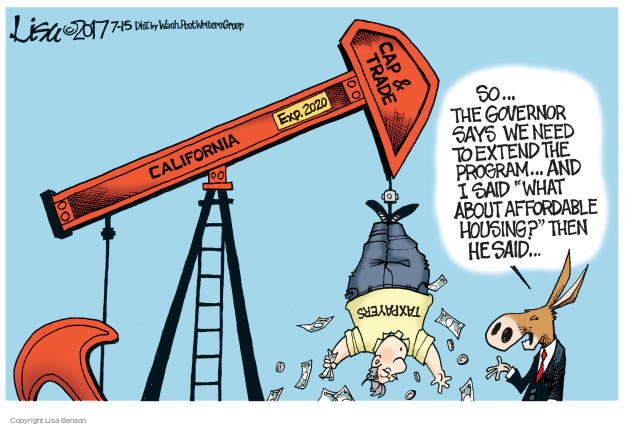
The Global Warming Solutions Act of 2006 (Assembly Bill 32), signed by Gov. Arnold Schwarzenegger, committed California to a goal of reducing statewide greenhouse gas emissions. The California Air Resources Board was required by AB 32 to write "scoping" plans every five years detailing how the specified GHG reduction targets would be met.
The 2017 scoping plan includes "guidelines" for new housing that the lawsuit calls "staggering, unlawful and racist."
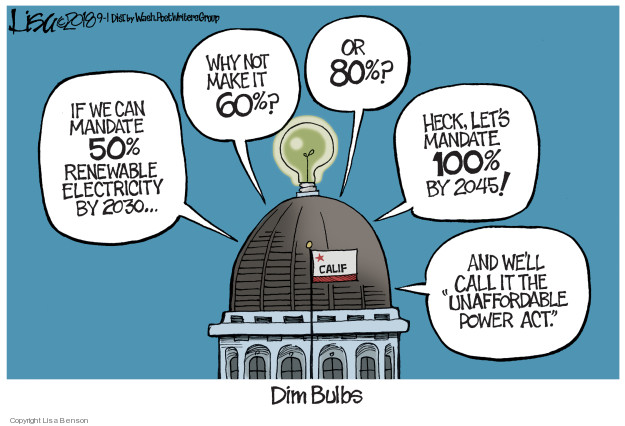
The group that is suing is called The Two Hundred. It's a Bay Area organization made up of longtime civil rights advocates who have spent decades fighting against discrimination. They say CARB's new GHG housing provisions have a "disparate effect on minority communities," which is illegal and unconstitutional.
CARB's provisions "increase the cost and litigation risks of building housing," intentionally worsen traffic congestion and raise fuel and electricity costs, the activists contend.
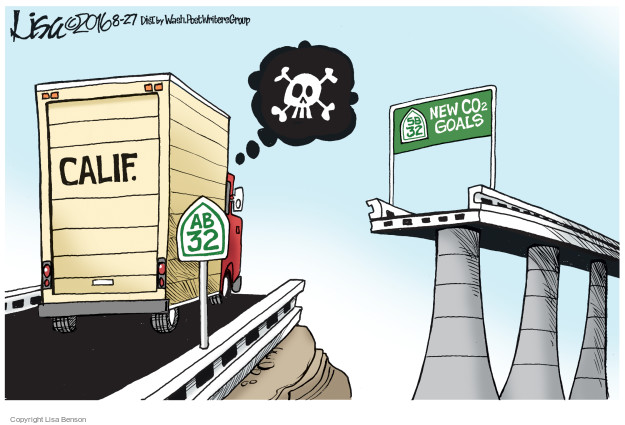
The lawsuit says CARB's scoping plan calls for new housing in "California's existing communities (which comprise 4 percent of California's lands)." The idea is to reduce "vehicle miles traveled" by limiting sprawl. But the civil rights activists say this is leading to resegregation of California's urban areas as older affordable housing is demolished to make way for high-density housing that is unaffordable.
A better solution, the group says, is to build homes on land that is outside the current urban boundaries, but CARB's 2017 scoping plan is preventing that. Its "guidelines" are helping to block new housing developments.

CARB tried unsuccessfully to get the lawsuit thrown out. Fresno County Superior Court Judge Jane Cardoza issued an order in October allowing it to go forward.
Unless there's a settlement, the courts will decide whether "California's climate change policies, and specifically those policies that increase the cost and delay or reduce the availability of housing, that increase the cost of transportation fuels and intentionally worsen highway congestion to lengthen commute times, and further increase electricity costs, have caused and will cause unconstitutional and unlawful disparate impacts to California's minority populations."

Not to mention their impact on everybody else.
There are four "GHG Housing Measures" at issue. They attempt to limit "vehicle miles traveled," set a "net zero" GHG standard for new housing developments and add a "CO2 per capita" measurement to local "climate action plans." There's also a set of policies to encourage "vibrant communities."
CARB says these "GHG Housing Measures" are only "guidelines," but the lawsuit calls them "unlawful underground regulations" that were imposed without a formal rulemaking process.

Something else that CARB skipped, the lawsuit charges, is the legally required economic analysis that "accounts for the cost of these measures on today's Californians."
Yes, civil rights activists are demanding that climate regulations meet the law's required standard of cost-effectiveness.

But California's climate regulations can't meet any standard of cost-effectiveness.
As the lawsuit explains it, "California's reputation as a global climate leader is built on the state's dual claims of substantially reducing greenhouse gas emissions while simultaneously enjoying a thriving economy. Neither claim is true."

The statewide economic growth numbers are misleading, the lawsuit says, because the averages are boosted by capital gains in the wealthy Bay Area tech sector, while most of the state struggles with low wages and high costs. And while Californians were paying too much for housing, fuel and electricity in order to achieve greenhouse gas reductions, other states actually had greater GHG reductions without doing anything.

"California's climate policies guarantee that housing, transportation and electricity prices will continue to rise while 'gateway' jobs to the middle class for those without college degrees, such as manufacturing and logistics, will continue to locate in other states," the lawsuit states.
This is something new in California. Civil rights activists are attempting to hold climate activists accountable for worsening the housing crisis and increasing poverty.

Maybe it's the political climate that's changing.
Susan Shelley is an editorial writer and columnist for the Southern California News Group. Susan@SusanShelley.com. Twitter: @Susan_Shelley.

By Paul Homewood
Harrabin is uncritically promoting the latest EU attempt to save the planet:

It is frustrating: you buy a new appliance then just after the warranty runs out, it gives up the ghost.
You can't repair it and can't find anyone else to at a decent price, so it joins the global mountain of junk.
You're forced to buy a replacement, which fuels climate change from the greenhouse gases released in the manufacturing process.
But help is at hand, because citizens in the EU and parts of the USA will soon get a "right to repair" – of sorts.
This consists of a series of proposals from European environment ministers to force manufacturers to make goods that last longer and are easier to mend.
The European proposals refer to lighting, televisions and large home appliances.
At least 18 US states are considering similar laws in a growing backlash against products which can't be prised apart because they're glued together, or which don't have a supply of spare parts, or repair instructions.
European environment ministers have a series of proposals forcing manufacturers to make goods that last longer and are easier to mend. The European proposals refer to lighting, televisions and large home appliances.
Plans for the EU Ecodesign Directive are complex and controversial. Manufacturers say the proposed rules on repairability are too strict and will stifle innovation.
Consumer campaigners complain the EU Commission has allowed firms to keep control of the repair process by insisting some products are mended by professionals under the control of manufacturers.
The European Environmental Bureau (EEB) said: "This restricts the access of independent repairers to spare parts and information – and that limits the scope and affordability of repair services." The EEB also wants other products like smart phones and printers included in the legislation.
Green groups say legislation under way in Europe and the US represents progress towards saving carbon emissions and using resources more wisely.
Libby Peake from the think tank Green Alliance told BBC News: "The new rules are a definite improvement. We think they could have been better, but it's good news that at last politicians are waking up to an issue that the public have recognised as a problem for a long time. The new rules will benefit the environment and save resources."
The policies have been driven by some arresting statistics.
This is no simple question. Resource analysts say, as a rule of thumb, if your current appliance is old and has a very low energy efficiency rating, it can sometimes be better in terms of lifetime CO2 emissions to replace it with a new model rated A or AA. In most other cases it produces fewer emissions sticking with the old model.
There's another debate about how readily consumers should be allowed to mend appliances. The Right to Repair movement wants products that can be fully disassembled and repaired with spare parts and advice supplied by the manufacturer.
Some manufacturers fear that bungling DIY repairers will damage the machines they're trying to fix, and potentially render them dangerous.
One industry group, Digital Europe, said: "We understand the political ambition to integrate strict energy and resource efficiency aspects in Ecodesign, but we are concerned that some requirements are either unrealistic or provide no added value.
"The draft regulations limit market access, deviate from internationally-recognised best practices and compromise intellectual property."
https://www.bbc.co.uk/news/science-environment-46797396
The one question he does not raise is whether these latest slew of regulations will simply put up prices for these consumer goods.
One of the big advantages of the way TVs and other home appliances are produced these days is that the use of integrated circuit boards and other parts reduce production costs. (Compare TVs now with the 1970s version which had umpteen valves and goodness knows what else).
Harrabin's logic is spurious anyway. He claims that we scrap appliances much sooner than we used to. There is, however, a very good reason for this. The cost of buying a new fridge or TV is much less than it was, even a few years ago. Economically it simply makes no sense spending £100 repairing an old TV when you can buy a new one for £300.
The European Environmental Bureau is even complaining that printers are not included in the proposed regulations. This is nonsense, given that new printers can be purchased for less than £50. Do the EEB really believe you can find someone willing to repair yours for less than the price of a new one?
As usual, it is all about "reducing emissions". The interest of consumers is the last thing the EU is worried about.


Snow-covered Swiss Alps [image credit: BBC]
A trio of researchers at École Polytechnique Fédérale de Lausanne has found that solar panels could provide a lot more power for Switzerland than has been previously thought, says TechXplore.
In their paper published in Proceedings of the National Academy of Sciences, Annelen Kahl, Jérôme Dujardin and Michael Lehning describe their feasibility study of solar panel use in mountainous Swiss regions using satellite data.
As part of Switzerland's Swiss Energy Strategy 2050, the government has decreed that all of the country's nuclear power plants will be phased out when their useful life has ended—and no new plants will be built to replace them.
Furthermore, all new power must come from renewable resources. Some might suggest this is a risky move, considering that currently, the country gets approximately 35 percent of its power from nuclear plants and just 5 percent from renewable resources.
But the country might have a previously unnoticed advantage—its high, snow-covered mountains. In this new effort, the researchers report evidence that such mountains could be used for generating a lot of electricity using solar panels.
Continued here.


Australia Wins The Global Patsy Award 2019
The Brookings Institute released a report that claims everyone is better off economically by sticking to Paris, but check out the devastating graphs. Economically, everyone is a loser, but the three biggest losers are Australia, Russia and OPEC.
Australia is doing more, paying more, suffering more and yet will make almost no difference to the global emissions tally in anything other than a purely symbolic impress-your-dinner–guests kind of way.
If Australia left the Paris Agreement, even the left leaning Brookings Institute can't find much difference in total global man-made emissions. Australia is forcing the renewables transformation faster than anywhere else, it will lose GDP, wages, jobs, investment, and the dollar will fall. All that, and no one could even tell the difference between Paris with Australia, and Paris without.
Clearly Australian negotiators at the UN are incompetent on a whole new scale. If they had Australian's interests at heart, even a little bit, they would have done this study themselves, and gone to Paris with some realistic comparative data to argue that we are cutting too fast and paying too much. Finalists for most useless Global Negotiator of the Decade are Kevin Rudd, [...]


