Thursday, January 3, 2019

Study shows the Sahara swung between lush and desert conditions every 20,000 years, in sync with monsoon activity

Image credit: BBC


These climatic swings (cycles) were in sync with changes in the Earth's tilt, say the researchers. They therefore believe ice ages are not the primary factor in these swings.

The Sahara desert is one of the harshest, most inhospitable places on the planet, covering much of North Africa in some 3.6 million square miles of rock and windswept dunes.

But it wasn't always so desolate and parched, reports Phys.org.

Primitive rock paintings and fossils excavated from the region suggest that the Sahara was once a relatively verdant oasis, where human settlements and a diversity of plants and animals thrived.

Now researchers at MIT have analyzed dust deposited off the coast of west Africa over the last 240,000 years, and found that the Sahara, and North Africa in general, has swung between wet and dry climates every 20,000 years.

They say that this climatic pendulum is mainly driven by changes to the Earth's axis as the planet orbits the sun, which in turn affect the distribution of sunlight between seasons—every 20,000 years, the Earth swings from more sunlight in summer to less, and back again.

For North Africa, it is likely that, when the Earth is tilted to receive maximum summer sunlight with each orbit around the sun, this increased solar flux intensifies the region's monsoon activity, which in turn makes for a wetter, "greener" Sahara.

When the planet's axis swings toward an angle that reduces the amount of incoming summer sunlight, monsoon activity weakens, producing a drier climate similar to what we see today.

"Our results suggest the story of North African climate is dominantly this 20,000-year beat, going back and forth between a green and dry Sahara," says David McGee, an associate professor in MIT's Department of Earth, Atmospheric and Planetary Sciences. "We feel this is a useful time series to examine in order to understand the history of the Sahara desert and what times could have been good for humans to settle the Sahara desert and cross it to disperse out of Africa, versus times that would be inhospitable like today."

McGee and his colleagues have published their results today in Science Advances.

Continued here.


from Climate Change Skeptic Blogs via hj on Inoreader http://bit.ly/2s7sOek

Wind turbines are neither clean nor green and they provide zero global energy

The Global Wind Energy Council recently released its latest report, excitedly boasting that 'the proliferation of wind energy into the global power market continues at a furious pace, after it was revealed that more than 54 gigawatts of clean renewable wind power was installed across the global market last year'.

You may have got the impression from announcements like that, and from the obligatory pictures of wind turbines in any BBC story or airport advert about energy, that wind power is making a big contribution to world energy today. You would be wrong. Its contribution is still, after decades - nay centuries - of development, trivial to the point of irrelevance.

Here's a quiz; no conferring. To the nearest whole number, what percentage of the world's energy consumption was supplied by wind power in 2014, the last year for which there are reliable figures? Was it 20 per cent, 10 per cent or 5 per cent? None of the above: it was 0 per cent. That is to say, to the nearest whole number, there is still no wind power on Earth.

Even put together, wind and photovoltaic solar are supplying less than 1 per cent of global energy demand. From the International Energy Agency's 2016 Key Renewables Trends, we can see that wind provided 0.46 per cent of global energy consumption in 2014, and solar and tide combined provided 0.35 per cent. Remember this is total energy, not just electricity, which is less than a fifth of all final energy, the rest being the solid, gaseous, and liquid fuels that do the heavy lifting for heat, transport and industry.

Such numbers are not hard to find, but they don't figure prominently in reports on energy derived from the unreliables lobby (solar and wind). Their trick is to hide behind the statement that close to 14 per cent of the world's energy is renewable, with the implication that this is wind and solar. In fact the vast majority - three quarters - is biomass (mainly wood), and a very large part of that is 'traditional biomass'; sticks and logs and dung burned by the poor in their homes to cook with. Those people need that energy, but they pay a big price in health problems caused by smoke inhalation.?

Even in rich countries playing with subsidized wind and solar, a huge slug of their renewable energy comes from wood and hydro, the reliable renewables. Meanwhile, world energy demand has been growing at about 2 per cent a year for nearly 40 years. Between 2013 and 2014, again using International Energy Agency data, it grew by just under 2,000 terawatt-hours.

If wind turbines were to supply all of that growth but no more, how many would need to be built each year? The answer is nearly 350,000, since a two-megawatt turbine can produce about 0.005 terawatt-hours per annum. That's one-and-a-half times as many as have been built in the world since governments started pouring consumer funds into this so-called industry in the early 2000s.

At a density of, very roughly, 50 acres per megawatt, typical for wind farms, that many turbines would require a land area greater than the British Isles, including Ireland. Every year. If we kept this up for 50 years, we would have covered every square mile of a land area the size of Russia with wind farms. Remember, this would be just to fulfill the new demand for energy, not to displace the vast existing supply of energy from fossil fuels, which currently supply 80 per cent of global energy needs.

Do not take refuge in the idea that wind turbines could become more efficient. There is a limit to how much energy you can extract from a moving fluid, the Betz limit, and wind turbines are already close to it. Their effectiveness (the load factor, to use the engineering term) is determined by the wind that is available, and that varies at its own sweet will from second to second, day to day, year to year.

As machines, wind turbines are pretty good already; the problem is the wind resource itself, and we cannot change that. It's a fluctuating stream of low-density energy. Mankind stopped using it for mission-critical transport and mechanical power long ago, for sound reasons. It's just not very good.

As for resource consumption and environmental impacts, the direct effects of wind turbines - killing birds and bats, sinking concrete foundations deep into wild lands - is bad enough. But out of sight and out of mind is the dirty pollution generated in Inner Mongolia by the mining of rare-earth metals for the magnets in the turbines. This generates toxic and radioactive waste on an epic scale, which is why the phrase 'clean energy' is such a sick joke and ministers should be ashamed every time it passes their lips.

It gets worse. Wind turbines, apart from the fiberglass blades, are made mostly of steel, with concrete bases. They need about 200 times as much material per unit of capacity as a modern combined cycle gas turbine. Steel is made with coal, not just to provide the heat for smelting ore, but to supply the carbon in the alloy. Cement is also often made using coal. The machinery of 'clean' renewables is the output of the fossil fuel economy, and largely the coal economy.

A two-megawatt wind turbine weighs about 250 tonnes, including the tower, nacelle, rotor and blades. Globally, it takes about half a tonne of coal to make a tonne of steel. Add another 25 tonnes of coal for making the cement and you're talking 150 tonnes of coal per turbine. Now if we are to build 350,000 wind turbines a year (or a smaller number of bigger ones), just to keep up with increasing energy demand, that will require 50 million tonnes of coal a year. That's about half the EU's hard coal-mining output.

Forgive me if you have heard this before, but I have a commercial interest in coal. Now it appears that the black stuff also gives me a commercial interest in 'clean', green wind power.

The point of running through these numbers is to demonstrate that it is utterly futile, on a priori grounds, even to think that wind power can make any significant contribution to world energy supply, let alone to emissions reductions, without ruining the planet. As the late David MacKay pointed out years back, the arithmetic is against such unreliable renewables.

The truth is, if you want to power civilization with fewer greenhouse gas emissions, then you should focus on shifting power generation, heat and transport to natural gas, the economically recoverable reserves of which - thanks to horizontal drilling and hydraulic fracturing - are much more abundant than we dreamed they ever could be. It is also the lowest-emitting of the fossil fuels, so the emissions intensity of our wealth creation can actually fall while our wealth continues to increase. Good.

And let's put some of that burgeoning wealth in nuclear, fission and fusion, so that it can take over from gas in the second half of this century. That is an engineerable, clean future. Everything else is a political displacement activity, one that is actually counterproductive as a climate policy and, worst of all, shamefully robs the poor to make the rich even richer.

Spectator.co.uk/podcast
Matt Ridley discusses wind power


from Climate Change Skeptic Blogs via hj on Inoreader http://www.icecap.us/

A Case Of Bad Statistics In An IQ-Intelligence Study

We're going to soon talk more about "IQ" and "intelligence". I'm working on a more in-depth article on the subject to carefully explicate the vast over-certainties I see on "both sides" in the debate. Consider this small post nothing but a throat clearing. I do not answer all questions here.

Because of a recent Twitter battle, it's clear there are two sides in the debate, which we may call the Sailerons, who follow Steve Sailer and who regularly commit the Deadly Sin of Reification of IQ with intelligence, and the Talebites, who follow Nassim Nicholas Taleb, a group which dismisses IQ scores of being of any real interest.

Briefly and incompletely, here is why I believe IQ is not intelligence. Those who tout IQ never bother to define intelligence except as ability to do well on certain kinds of tests. How do we know these tests measure intelligence? Because those who score high are smart. This is circular. Why this circularity exists and what extra-test definitions of intelligence are, I save for the other article. I do not mean this paragraph as a proof, so no histrionics, please.

The Talebites wave aside test results, saying, for instance, that they're not especially useful in discerning differences in successful people. This misses that idea that the pool of people who are not a success probably didn't score well on those tests. Even if IQ properly measures intelligence (which it does in some aspects, but as through a glass darkly), we would expect there to be no correlation of IQ and success at the bottom of professions (among just those people there) and at the top.

This next proposition should be uncontroversial: IQ tests are useful at predicting the ability to answer questions or to complete tasks that are like the questions used in IQ tests. This is almost tautological (leaving out that testing environments are different than real life). An equivalent proposition is: Baking tests are useful at predicting the ability of people to be successful bakers. It is obvious that it takes more than mere baking skills to be a successful baker; that one number is insufficient at describing baking ability. Yet that number will correlate well (in the statistical sense) with other standard measures of success, such as income, and even health.

Now you will hear from the Sailerons that, of course they don't believe one number can capture all there is to a person's intelligence. In practice, they violate that commitment routinely, reifying with wild abandon, especially when it comes to differences in populations. Yet I nowhere among the Talebites find the absence of reification, either. Everybody, with rare exception, says people "have" an IQ or that IQ is "real".

No. Most people do not have an IQ. Only the people who have taken an IQ test have an IQ score: IQ is only a score on a test. All people have intelligence—of varying degree (I reject categorically any hint of Equality or blank-slatism). Intelligence, as I will prove later, and which anyway should have always been obvious, is much more than a test score.

Here, then, is just one small example from an army of examples of how things go wrong when people do not begin with solid foundations. What happened (a multi-cars-on-the-highway-in-the-blizzard wreck) would not have happened if the folks responsible would have begun with a multifaceted, metaphysically sound definition of intelligence. And if they eschewed p-values.

The peer-reviewed paper, published in the International Journal of Epidemiology, by Arden et al. ("authors"), is "The association between intelligence and lifespan is mostly genetic."

Wow! What a title!

Given my vast cognitive abilities, which are plain to all, but especially to me, I should live forever!

Just look at what is claimed, at least tacitly. At least that the authors have an unambiguous definition of intelligence. A first for this field. And that the same genes which cause big brains also cause long lives. Deep and important.

And silly. The Deadly Sin of Reification has struck. IQ test scores have become intelligence.

Well, so what. So change the title to "The association between IQ scores and lifespan is mostly genetic" and all is fixed. Alas, no. First, because the reification of IQ scores as intelligence is so ingrained, everybody will see "IQ" but believe "intelligence". Second, and damning, we have wee p-values, outrageous data selection, and shades of the epidemiologist fallacy.

Jay S Kaufman and Carles Muntaner ("critics") where so aghast at what the authors claimed, they submitted a rebuttal, which is must reading. They did such a marvelous job listing the authors' many shortcomings and mistakes that there is no reason for me to repeat their words. I shall assume you (yes, even you) are among the minority who will read them.

A couple of highlights. The critics said the authors relied "on null hypothesis significance testing rather than reporting of effect estimates and their imprecision". The rebuttal by the authors was to say they did not, at least in the abstract (ceding that they did in the paper).

The authors studied twins' life spans, relying on a bizarre method of data inclusion.

If at least one twin died by the time of the study assessment, then the pair was included in the analysis, but the survival difference could not be calculated if the second twin was still alive, which was true in about half of the pairs analysed. In that case the authors imputed the death date for this surviving twin by using the national average for a person of the same birth year and sex.

Industrial-grade over-certainty there. But it's even worse. "Moreover, in some instances, the authors found that the person had already reached their life table estimated survival, and so they assigned this person to die in the same year…" Dude. And what about measures of genes themselves and the causal pathways to actual lifetime and actual intelligence, or even just IQ scores? Didn't happen. More assumptions were inserted for measurement.

Next we need this headline, from a different paper (in New Scientist, the ex-communist magazine, now suitably morphed). "Exclusive: A new test can predict IVF embryos' risk of having a low IQ."

Did they say risk of "low IQ", as if IQ were intelligence and having low intelligence was like having a disease? Yes, sir, they did. Isn't that sad and stupid? Yes, sir, it is. But it is representative of what happens when you never bother to define intelligence except circularly.

The authors (in the rebuttal) say "Cognitive epidemiology is the field of study that explores links between intelligence, health and mortality." Health and mortality we can define with only some ambiguity (mortality is certain). But what is their definition of intelligence? IQ. With no idea that IQ is just as well seen as a measure of cultural achievement as intelligence (I mean this only a loose sense; don't have palpitations). Cultural achievement is, after all, how the questions in IQ tests are picked. (This is not to claim IQ scores have nothing to say about intelligence, suitably defined. And if IQ is predictive, however loosely, with cultural achievement, it is still useful when considering Diversity.)

We can now see why the critics said "To consider IQ, as a marker of a disease or variation in test scores, as a condition to be prevented or treated is absurd."

There is no more a cognitive epidemiology than there is a memory, perception or emotional epidemiology. These are basic psychological processes, not diseases, therefore not targets of prevention or treatment. A loss of functional cognition, such as occurs in dementia, can be studied as a disease outcome, but variation in intelligence test scores in the population is not such a quantity. Nor is IQ a well-defined exposure even if it were relevant to public health. The misconception of using IQ or other markers of cognitive performance as causes of disease or death, to be prevented or treated at the population level, has had devastating effects in the past century.

As apt and true as that warning is, the hunger for certainty and the mania for measurement assures that we will see many similar mistakes in the future.


from Climate Change Skeptic Blogs via hj on Inoreader http://bit.ly/2R73h43

Manganese dioxide nanoparticles/activated carbon composite as efficient UV and visible-light photocatalyst

Abstract

Manganese dioxide nanoparticles/activated carbon (MnO2/AC) composites and manganese dioxide nanoparticles (MnO2 NPs) are prepared through chemical reduction method. Morphological study shows that MnO2 NPs had cylindrical and spherical shape. The morphological study also revealed that MnO2 NPs were well dispersed on AC while neat Mn NPs present both in dispersed and in agglomerated form. The FT-IR study confirms the synthesis of MnO2 NPs. Zetasizer study presented that the Mn NPs had uniform size and below 100 nm in size and had zeta potential of − 20 mV, which represent its stability in the suspension form. The synthesized Mn/AC composite and Mn NPs were utilized as photocatalysts for the photodegradation of Congo red (CR) dye. The degradation study shows that MnO2/AC composite degraded CR dye more efficiently than MnO2 NPs under UV and normal light irradiation. The efficient degradation of dye by Mn/AC composite is due to the synergistic effect between dye adsorption on AC and rapid photodegradation by supported MnO2 NPs. The results revealed that Mn/AC composite degraded about 98.53% of CR dye within 5 min while MnO2 NPs degraded 66.57% of dye within the same irradiation time. The recycled catalyst also significantly degraded dye which verifies its sustainability. The effect of catalyst dosage and initial dye concentration was conducted. The degradation rate of dye was found drastically faster in tap water (in presence of catalyst), which might be due to the presence of various mineral ions in the tap water.


from Climate Change Skeptic Blogs via hj on Inoreader http://bit.ly/2ArPpqw

Consensus? 500+ Scientific Papers Published In 2018 Support A Skeptical Position On Climate Alarm

In 2018,  over 500 scientific papers were published that cast doubt on the position that anthropogenic CO2 emissions function as the climate's fundamental control knob…or that otherwise serve to question the efficacy of climate models or the related "consensus" positions commonly endorsed by policymakers and mainstream media sources.

Climate-Alarm-Unsettles-in-2018.jpg

More than 500 scientific papers published in 2018 affirm the position that there are significant limitations and uncertainties inherent in our understanding of climate and climate changes, emphasizing that climate science is not settled.

More specifically, the papers in this compilation support these four main skeptical positions — categorized here as N(1) – N(4) — which question the climate alarm popularized in today's headlines.

N(1) Natural mechanisms play well more than a negligible role (as claimed by the IPCC) in the net changes in the climate system, which includes temperature variations, precipitation patterns, weather events, etc., and the influence of increased CO2 concentrations on climatic changes are less pronounced than currently imagined.

Solar Influence On Climate (103)
ENSO, NAO, AMO, PDO Climate Influence (22)
Modern Climate In Phase With Natural Variability (8)
Cloud/Aerosol Climate Influence (4)
Volcanic/Tectonic Climate Influence (3)

N(2) The warming/sea levels/glacier and sea ice retreat/hurricane and drought intensities…experienced during the modern era are neither unprecedented or remarkable, nor do they fall outside the range of natural variability.

No Net Warming Since Mid/Late 20th Century (36)
A Warmer Past: Non-Hockey Stick Reconstructions (76)
Lack Of Anthropogenic/CO2 Signal In Sea Level Rise (16)
Sea Levels Multiple Meters Higher 4,000-7,000 Years Ago (18)
Nothing Unusual Occurring With Glaciers, Polar Ice (33)
Polar Bear (and other) Populations Not Decreasing (10)
Warming, Acidification Not Harming Oceanic Biosphere (10)
Coral Bleaching A Natural, Non-Anthropogenic Phenomenon (2)
No Increasing Trends In Intense Hurricanes/Storms (8)
No Increasing Trend In Drought/Flood Frequency, Severity (7)
Global Fire Frequency Declining As CO2 Rises (2)
CO2 Changes Lag Temperature Changes By 1000+ Years (3)

N(3) The computer climate models are neither reliable or consistently accurate, the uncertainty and error ranges are irreducible, and projections of future climate states (i.e., an intensification of the hydrological cycle) are not supported by observations and/or are little more than speculation.

Climate Model Unreliability/Biases/Errors (27)
No AGW Changes To Hydrological Cycle Detectable (6)
The CO2 Greenhouse Effect – Climate Driver? (12)

N(4) Current emissions-mitigation policies, especially related to the advocacy for renewables, are often ineffective and even harmful to the environment, whereas elevated CO2 and a warmer climate provide unheralded benefits to the biosphere (i.e., a greener planet and enhanced crop yields, lower mortality with warming).

Failing Renewable Energy, Climate Policies (17)
Wind Power Harming The Environment, Biosphere (19)
Elevated CO2: Greens Planet, Higher Crop Yields (20)
Global Warming Saves Lives. Cold Kills. (9)
Global Losses/Deaths From Weather Disasters Declining (2)

In sharp contrast to the above, the corresponding "consensus" positions that these papers do not support are:

A(1) Close to or over 100% (110%) of the warming since 1950 has been caused by increases in anthropogenic CO2 emissions, leaving natural attribution at something close to 0%.

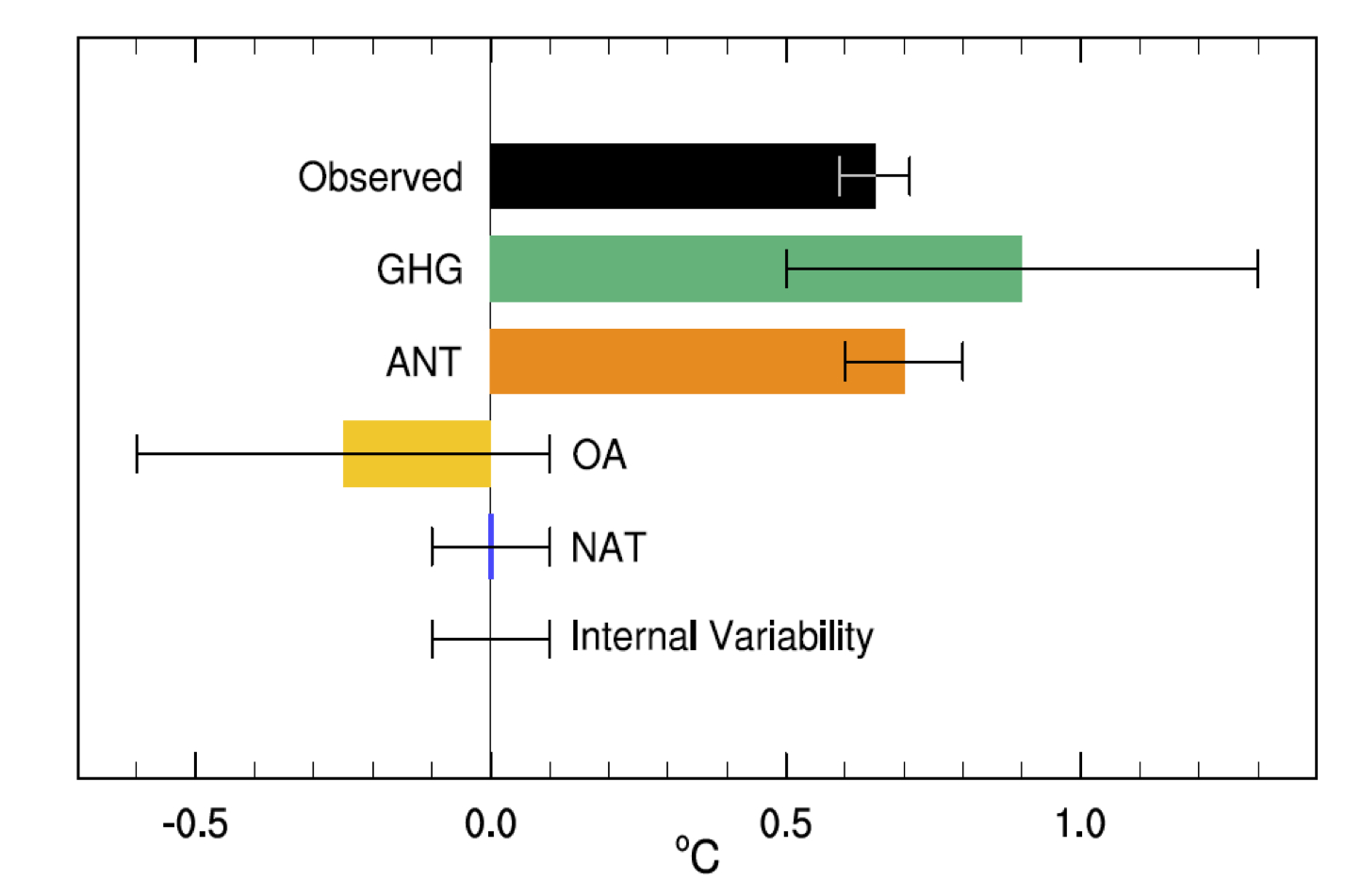
RealClimate.org: "The best estimate of the warming due to anthropogenic forcings (ANT) is the orange bar (noting the 1𝛔 uncertainties). Reading off the graph, it is 0.7±0.2ºC (5-95%) with the observed warming 0.65±0.06 (5-95%). The attribution then follows as having a mean of ~110%, with a 5-95% range of 80–130%. This easily justifies the IPCC claims of having a mean near 100%, and a very low likelihood of the attribution being less than 50% (p < 0.0001!)."

A(2) Modern warming, glacier and sea ice recession, sea level rise, drought and hurricane intensities…are all occurring at unprecedentedly high and rapid rates, and the effects are globally synchronous (not just regional)…and thus dangerous consequences to the global biosphere and human civilizations loom in the near future as a consequence of anthropogenic influences.

A(3) The climate models are reliable and accurate, and the scientific understanding of the effects of both natural forcing factors (solar activity, clouds, water vapor, etc.) and CO2 concentration changes on climate is "settled enough", which means that "the time for debate has ended".

A(4) The proposed solutions to mitigate the dangerous consequences described in N(4) – namely, wind and solar expansion – are safe, effective, and environmentally-friendly.

To reiterate, the 500+ papers compiled in 2018 support the N(1)-N(4) positions, and they undermine or at least do not support the "consensus"A(1)-A(4) positions.  These papers do not do more than that.   In other words, it is not accurate to claim these papers prove that anthropogenic global warming (AGW) positions are invalid, or that AGW claims have now been "debunked".

There were just over 500 papers published in 2016.  Skeptic Papers 2016

There were just under 500 papers published in 2017.  Skeptic Papers 2017

Between 2016 and 2018 there were about 1,500 peer-reviewed scientific papers published that support a skeptical position on climate alarm.

Below are the three links to the list of scientific papers for 2018 as well as an outline to their categorization.

Skeptic Papers 2018 (1)

Skeptic Papers 2018 (2)

Skeptic Papers 2018 (3)

1. Climate Change Observation, Reconstruction (189)

No Net Warming Since Mid/Late 20th Century (36)
A Warmer Past: Non-Hockey Stick Reconstructions (76)
Lack Of Anthropogenic/CO2 Signal In Sea Level Rise (16)
Sea Levels Multiple Meters Higher 4,000-7,000 Years Ago (18)
Nothing Unusual Occurring With Glaciers, Polar Ice (33)
Mass Extinction Events Caused By Glaciation, Sea Level Fall (3)
Antarctic Ice Melting In High Geothermal Heat Flux Areas (2)
Abrupt, Degrees-Per-Decade Natural Global Warming (5)

2. Natural Mechanisms Of Weather, Climate Change (152)

Solar Influence On Climate (103)
ENSO, NAO, AMO, PDO Climate Influence (22)
Modern Climate In Phase With Natural Variability (8)
Cloud/Aerosol Climate Influence (4)
Volcanic/Tectonic Climate Influence (3)
The CO2 Greenhouse Effect – Climate Driver? (12)

3. Unsettled Science, Failed Climate Modeling (161)

Climate Model Unreliability/Biases/Errors (27)
Urban Heat Island: Raising Surface Temperatures Artificially (5)
Failing Renewable Energy, Climate Policies (17)
Wind Power Harming The Environment, Biosphere (19)
Elevated CO2: Greens Planet, Higher Crop Yields (20)
Polar Bear (and other) Populations Not Decreasing (10)
Global Warming Saves Lives. Cold Kills. (9)
Warming, Acidification Not Harming Oceanic Biosphere (10)
Coral Bleaching Is A Natural, Non-Anthropogenic Phenomenon (2)
No Increasing Trends In Intense Hurricanes/Storms (8)
No Increasing Trend In Drought/Flood Frequency, Severity (7)
Natural CO2 Emissions A Net Source, Not A Net Sink (5)
Global Fire Frequency Declining As CO2 Rises (2)
CO2 Changes Lag Temperature Changes By 1000+ Years (3)
Global Losses/Deaths From Weather Disasters Declining (2)
No AGW Changes To Hydrological Cycle Detectable (6)
Peak Oil As Myth (3)
Miscellaneous (16)


from Climate Change Skeptic Blogs via hj on Inoreader http://bit.ly/2SA2JAe

Assessment of some heavy metal accumulation and nutritional quality of shellfish with reference to human health and cancer risk assessment: a seafood safety approach

Abstract

This study was conducted to assess the proximate analysis (protein, carbohydrate, lipid, and moisture content) and concentration levels of metals (Zn, Cu, Cd, Pb, and Cr) in the muscles of selected shellfish (Portunus reticulatus, P. segnis, P. sanguinolentus, Scylla olivaceae, Penaeus monodon, and P. indicus) species. The concentration of metals showed significant difference (p > 0.05) among species. The detected concentrations of the analyzed heavy metals were below the daily intake and legal limits set by national and international standards. The THQs and CR index were calculated to evaluate the risk estimation of the metal contamination associated with the human health. The THQ values of all metals were below 1 in all species, indicated that there is no risk of adverse health effect, but the risk of elevated intakes of heavy metals adversely affecting food safety for the studied species. The CR index indicated that Cd and Pb caused the greatest cancer risk. The correlation and multivariate (principle component analysis) among metal concentration and nutritional quality were also evaluated. The carbohydrate and moisture showed the positive correlation (p > 0.05) with metals. The biochemical results of the present work clearly indicate that there was a significant difference in the muscles of shellfish. It was concluded that more effective controls should be focused on Cd and Pb to reduce pollution for quality and seafood safety concern.


from Climate Change Skeptic Blogs via hj on Inoreader http://bit.ly/2F5Yjxi

Adsorption of indigo carmine on Pistia stratiotes dry biomass chemically modified

Abstract

Pistia stratiotes is a common aquatic plant of the northern region of the state of Rio de Janeiro, and its use as adsorbent material was studied in the present work. The preparation process included washing, drying, grinding, and acid activation. The sorption potential for removal of the indigo carmine dye from aqueous solutions was tested under various conditions, such as initial concentration, contact time, and temperature. The tests showed that the obtained biosorbent showed good performance for dye removal with a maximum capacity of 41.2 mg/g. The kinetic studies revealed that the pseudo-second-order equation provided the best fit of the experimental data. The Freundlich isotherm provided the best fit of the experimental sorption data for the system under study. The results obtained show that Pistia stratiotes has great potential to be used as biosorbent for the removal of dyes from aqueous solutions.


from Climate Change Skeptic Blogs via hj on Inoreader http://bit.ly/2TpZuLQ

A ratiometric fluorescent probe of methionine sulfoxide reductase with improved response rate and emission wavelength

Chem. Commun., 2019, Accepted Manuscript
DOI: 10.1039/C8CC08879A, Communication
Liangwei Zhang, Shoujiao Peng, Jinyu Sun, Ruijuan Liu, Shudi Liu, Jianguo Fang
A ratiometric fluorescent probe of methionine sulfoxide reductase, Msr-Ratio, was disclosed for monitoring the enzyme activity in vitro and in live cells. The probe displays favorable properties, such as nearly...
The content of this RSS Feed (c) The Royal Society of Chemistry


from Journals via hj on Inoreader https://rsc.li/2F6ZT2w

Sub-100 °C aluminum ion battery based on ternary inorganic molten salt

Chem. Commun., 2019, Accepted Manuscript
DOI: 10.1039/C8CC09677E, Communication
Haijun Yu, Jie Wang, Xu Zhang, Weiqing Chu, Shiqi Liu
By using a low-cost, ternary AlCl3/LiCl/KCl inorganic molten salt as the electrolyte, an aluminum ion battery is able to work stably below 100 °C. When intergrated with a graphite paper...
The content of this RSS Feed (c) The Royal Society of Chemistry


from Journals via hj on Inoreader https://rsc.li/2F5roZO

Wednesday, January 2, 2019

Influenza : Antiviral Chemoprophylaxis

 in Community Settings

X. Who should be considered for antiviral chemoprophylaxis to prevent influenza in the absence of exposure or an institutional outbreak (preexposure chemoprophylaxis)?

Antiviral drugs should not be used for routine or widespread chemoprophylaxis outside of institutional outbreaks; antiviral chemoprophylaxis can be considered in certain situations:

  1. Clinicians can consider antiviral chemoprophylaxis for the duration of the influenza season for adults and children aged ≥3 months who are at very high risk of developing complications from influenza and for whom influenza vaccination is contraindicated, unavailable, or expected to have low effectiveness (eg, persons who are severely immunocompromised) (C-II).
  2. Clinicians can consider antiviral chemoprophylaxis for the duration of the influenza season for adults and children aged ≥3 months who have the highest risk of influenza-associated complications, such as recipients of hematopoietic stem cell transplant in the first 6–12 months posttransplant and lung transplant recipients (B-II).
  3. Clinicians can consider short-term antiviral chemoprophylaxis in conjunction with prompt administration of inactivated influenza vaccine for unvaccinated adults and children aged ≥3 months who are at high risk of developing complications from influenza in whom influenza vaccination is expected to be effective (but not yet administered) when influenza activity has been detected in the community (C-II).
  4. Clinicians can consider short-term antiviral chemoprophylaxis for unvaccinated adults, including healthcare personnel, and for children aged ≥3 months who are in close contact with persons at high risk of developing influenza complications during periods of influenza activity when influenza vaccination is contraindicated or unavailable and these high-risk persons are unable to take antiviral chemoprophylaxis (C-III).
  5. Clinicians can consider educating patients and parents of patients to arrange for early empiric initiation of antiviral treatment as an alternative to antiviral chemoprophylaxis (C-III).

XI. Which antiviral drugs should be used for preexposure chemoprophylaxis for influenza?

  1. Clinicians should use an NAI (oral oseltamivir or inhaled zanamivir) if preexposure chemoprophylaxis for influenza is administered rather than an adamantane antiviral (A-II).

XII. What is the duration of preexposure antiviral chemoprophylaxis to prevent influenza?

  1. Clinicians should administer preexposure antiviral chemoprophylaxis for adults and children aged ≥3 months who are at very high risk of developing complications from influenza (eg, severely immunocompromised persons such as hematopoietic stem cell transplant recipients) for whom influenza vaccination is contraindicated, unavailable, or expected to have low effectiveness, as soon as influenza activity is detected in the community and continued for the duration of community influenza activity (A-II).
  2. Clinicians should test for influenza and switch to antiviral treatment dosing in persons receiving preexposure antiviral chemoprophylaxis who become symptomatic, preferably with an antiviral drug with a different resistance profile if not contraindicated (A-II).

XIII. Which asymptomatic persons exposed to influenza should be considered for postexposure antiviral chemoprophylaxis in a noninstitutional setting?

  1. Clinicians can consider postexposure antiviral chemoprophylaxis for asymptomatic adults and children aged ≥3 months who are at very high risk of developing complications from influenza (eg, severely immunocompromised persons) and for whom influenza vaccination is contraindicated, unavailable, or expected to have low effectiveness, after household exposure to influenza (C-II).
  2. Clinicians can consider postexposure antiviral chemoprophylaxis (in conjunction with influenza vaccination) for adults and children aged ≥3 months who are unvaccinated and are household contacts of a person at very high risk of complications from influenza (eg, severely immunocompromised persons), after exposure to influenza (C-II).
  3. Clinicians can consider educating patients and arranging for early empiric initiation of antiviral treatment as an alternative to postexposure antiviral chemoprophylaxis (C-III).

XIV. When should postexposure antiviral chemoprophylaxis be started?

  1. If chemoprophylaxis is given, clinicians should administer postexposure antiviral chemoprophylaxis as soon as possible after exposure, ideally no later than 48 hours after exposure (A-III).
  2. Clinicians should not administer once-daily postexposure antiviral chemoprophylaxis if >48 hours has elapsed since exposure. Full-dose empiric antiviral treatment should be initiated as soon as symptoms occur, if treatment is indicated (A-III).

XV. How long should postexposure antiviral chemoprophylaxis be given?

  1. Clinicians should administer postexposure antiviral chemoprophylaxis in a nonoutbreak setting for 7 days after the most recent exposure to a close contact with influenza (A-III).
  2. Clinicians should test for influenza and switch to antiviral treatment dosing in persons receiving postexposure antiviral chemoprophylaxis who become symptomatic, preferably with an antiviral drug with a different resistance profile if not contraindicated (A-III).

XVI. Which antiviral drugs should be used for postexposure chemoprophylaxis?

  1. Clinicians should administer an NAI (inhaled zanamivir or oral oseltamivir) if postexposure chemoprophylaxis for influenza is given, rather than an adamantane antiviral (A-II).

https://www.idsociety.org/practice-guideline/influenza/

Evaluation and investigation of the effects of ventilation layout, rate, and room temperature on pollution dispersion across a laboratory indoor environment

Abstract

The presence of chemicals in laboratories and research centers exposes the staff working at such indoor environment to health risks. In this piece of research, a study was performed on the indoor environment of the Center for Environmental Engineering Research at Sahand University of Technology (Tabriz, Iran). For this purpose, the parameters affecting the dispersion of volatile organic compounds (VOCs), including ventilation rate, room temperature, pollution emission time, venting location, air flow regime within the indoor environment, and the number of vents, were simulated via CFD modeling. The CFD modeling was performed three-dimensionally in unsteady state. In case of turbulent flow within the indoor environment, k–ε turbulence model was used to obtain air velocity profile. Experimental data was used to validate the model. Results of the present research showed that when the venting location is on the ceiling, pollution concentration of 25 ppm can be achieved at some low temperature under a particular set of conditions. However, when the venting location was on the walls close to the pollution source, concentrations as low as 5 ppm and lower were observed within the laboratory indoor environment.


from Climate Change Skeptic Blogs via hj on Inoreader http://bit.ly/2F5LiVg

Alleviative role of exogenously applied mannitol in maize cultivars differing in chromium stress tolerance

Abstract

A pot experiment was performed to examine the role of foliar applied mannitol (M) in chromium (Cr) stress alleviation in different maize cultivars. Two maize cultivars, one tolerant (6103) and one sensitive (9108) to chromium stress, were grown in soil treated with three concentrations of Cr (0, 5, and 10 mg kg−1) and three levels of mannitol (0, 50, and 100 mg L−1). Chromium stress decreased the overall growth of plants by reducing the plant height, root/shoot dry weight, chlorophyll contents, and enzymatic activities, while exacerbated the severity of reactive oxygen species in both maize cultivars. Chromium-induced reduction in growth attributes of maize plants was relatively higher in sensitive cultivar than that of tolerant one. Uptake of Cr by the plants and its translocation from roots to shoots increased with increasing concentration in the soil. However, foliar application of mannitol significantly alleviated the Cr stress and improved growth, biomass, and photosynthetic pigments of maize plants. Mannitol also considerably reduced Cr contents in leaves and roots of both cultivars. Hence, it is concluded that mannitol can be helpful for crops grown on heavy metal, especially Cr, contaminated soils for remediation purpose.


from Climate Change Skeptic Blogs via hj on Inoreader http://bit.ly/2F2U6ue

Correction to: China’s provincial CO 2 emissions and interprovincial transfer caused by investment demand

The original publication of this paper contains a mistake. The correct image of figure 4 is shown in this paper. The original article has been corrected.


from Climate Change Skeptic Blogs via hj on Inoreader http://bit.ly/2s7Mgrw

2018 Saw A Global Revolt Against Climate Change Policies

RTS29C9L-1.jpg

From The Daily Caller 12:01 PM 12/31/2018 | Energy Michael Bastasch | Energy Editor 2018 saw a global revolt against policies aimed at fighting global warming Australia, Canada, France and the U.S. have all seen push back against global warming policies That included weeks of riots in France against planned carbon tax increases Despite increasingly…

from Climate Change Skeptic Blogs via hj on Inoreader http://bit.ly/2TnfyxW

Influenza : Treatment


IV. Which patients with suspected or confirmed influenza should be treated with antivirals?

  1. Clinicians should start antiviral treatment as soon as possible for adults and children with documented or suspected influenza, irrespective of influenza vaccination history, who meet the following criteria:
    • Persons of any age who are hospitalized with influenza, regardless of illness duration prior to hospitalization (A-II).
    • Outpatients of any age with severe or progressive illness, regardless of illness duration (A-III).
    • Outpatients who are at high risk of complications from influenza, including those with chronic medical conditions and immunocompromised patients (A-II).
    • Children younger than 2 years and adults ≥65 years (A-III).
    • Pregnant women and those within 2 weeks postpartum (A-III).
  1. Clinicians can consider antiviral treatment for adults and children who are not at high risk of influenza complications, with documented or suspected influenza, irrespective of influenza vaccination history, who are either:
    • Outpatients with illness onset ≤2 days before presentation (C-I).
    • Symptomatic outpatients who are household contacts of persons who are at high risk of developing complications from influenza, particularly those who are severely immunocompromised (C-III).
    • Symptomatic healthcare providers who care for patients who are at high risk of developing complications from influenza, particularly those who are severely immunocompromised (C-III)

V. For patients who are recommended to receive antiviral treatment for suspected or confirmed influenza, which antiviral should be prescribed, at what dosing, and for what duration?

  1. Clinicians should start antiviral treatment as soon as possible with a single neuraminidase inhibitor (NAI) (either oral oseltamivir, inhaled zanamivir, or intravenous peramivir) and not use a combination of NAIs (A-I).
  2. Clinicians should not routinely use higher doses of US Food and Drug Administration–approved NAI drugs for the treatment of seasonal influenza (A-II).
  3. Clinicians should treat uncomplicated influenza in otherwise healthy ambulatory patients for 5 days with oral oseltamivir or inhaled zanamivir, or a single dose of intravenous peramivir (A-I).
  4. Clinicians can consider longer duration of antiviral treatment for patients with a documented or suspected immunocompromising condition or patients requiring hospitalization for severe lower respiratory tract disease (especially pneumonia or acute respiratory distress syndrome [ARDS]), as influenza viral replication is often protracted (C-III).

VI. In a patient with suspected or confirmed influenza, when should bacterial coinfectoin of the upper or lower respiratory tract be considered, investigated, and treated?

  1. Clinicians should investigate and empirically treat bacterial coinfection in patients with suspected or laboratory-confirmed influenza who present initially with severe disease (extensive pneumonia, respiratory failure, hypotension, and fever), in addition to antiviral treatment for influenza (A-II).
  2. Clinicians should investigate and empirically treat bacterial coinfection in patients who deteriorate after initial improvement, particularly in those treated with antivirals (A-III).
  3. Clinicians can consider investigating bacterial coinfection in patients who fail to improve after 3–5 days of antiviral treatment (C-III).

VII. If a patient with influenza does not demonstrate clinical improvement with antiviral treatment or demonstrates clinical deterioration during or after treatment, what additional testing and therapy should be considered?

  1. Clinicians should investigate other causes besides influenza virus infection in influenza patients who fail to improve or deteriorate despite antiviral treatment (A-III).

VIII. When should testing be done for infection with an antiviral-resistant influenza virus?

  1. Influenza NAI resistance testing can be considered for:
    • Patients who develop laboratory-confirmed influenza while on or immediately after NAI chemoprophylaxis (C-III).
    • Patients with an immunocompromising condition and evidence of persistent influenza viral replication (eg, after 7–10 days, demonstrated by persistently positive RT-PCR or viral culture results) and remain ill during or after NAI treatment (B-III).
    • Patients with laboratory-confirmed influenza who inadvertently received subtherapeutic NAI dosing (C-III).
    • Patients with severe influenza who do not improve with NAI treatment and have evidence of persistent influenza viral replication (eg, after 7–10 days) (C-II).
  1. Clinicians should remain informed on current CDC and World Health Organization surveillance data on the frequency and geographic distribution of NAI-resistant influenza viruses during influenza season, and with the latest CDC antiviral treatment recommendations (A-III).

IX. Should adjunctive therapy be administered to patients with suspected or confirmed influenza?

  1. Clinicians should not administer corticosteroid adjunctive therapy for the treatment of adults or children with suspected or confirmed seasonal influenza, influenza-associated pneumonia, respiratory failure, or ARDS, unless clinically indicated for other reasons (A-III).
  2. Clinicians should not routinely administer immunomodulation using immunoglobulin preparations such as intravenous immunoglobulin for treatment of adults or children with suspected or confirmed seasonal influenza (A-III).

https://www.idsociety.org/practice-guideline/influenza/

Influenza : For patients who are recommended to receive antiviral treatment for suspected or confirmed influenza, which antiviral should be prescribed, at what dosing, and for what duration?


Clinicians should start antiviral treatment as soon as possible with a single neuraminidase inhibitor (NAI) (either oral oseltamivir, inhaled zanamivir, or intravenous peramivir) and not use a combination of NAIs (A-I).
Clinicians should not routinely use higher doses of US Food and Drug Administration–approved NAI drugs for the treatment of seasonal influenza (A-II).
Clinicians should treat uncomplicated influenza in otherwise healthy ambulatory patients for 5 days with oral oseltamivir or inhaled zanamivir, or a single dose of intravenous peramivir (A-I).
Clinicians can consider longer duration of antiviral treatment for patients with a documented or suspected immunocompromising condition or patients requiring hospitalization for severe lower respiratory tract disease (especially pneumonia or acute respiratory distress syndrome [ARDS]), as influenza viral replication is often protracted (C-III).
https://www.idsociety.org/practice-guideline/influenza/

Which patients with suspected or confirmed influenza should be treated with antivirals?

Clinicians should start antiviral treatment as soon as possible for adults and children with documented or suspected influenza, irrespective of influenza vaccination history, who meet the following criteria:
Persons of any age who are hospitalized with influenza, regardless of illness duration prior to hospitalization (A-II).
Outpatients of any age with severe or progressive illness, regardless of illness duration (A-III).
Outpatients who are at high risk of complications from influenza, including those with chronic medical conditions and immunocompromised patients (A-II).
Children younger than 2 years and adults ≥65 years (A-III).
Pregnant women and those within 2 weeks postpartum (A-III).
Clinicians can consider antiviral treatment for adults and children who are not at high risk of influenza complications, with documented or suspected influenza, irrespective of influenza vaccination history, who are either:
Outpatients with illness onset ≤2 days before presentation (C-I).
Symptomatic outpatients who are household contacts of persons who are at high risk of developing complications from influenza, particularly those who are severely immunocompromised (C-III).
Symptomatic healthcare providers who care for patients who are at high risk of developing complications from influenza, particularly those who are severely immunocompromised (C-III)
https://www.idsociety.org/practice-guideline/influenza/

What test(s) should be used to diagnose influenza?

  1. Clinicians should use rapid molecular assays (ie, nucleic acid amplification tests) over rapid influenza diagnostic tests (RIDTs) in outpatients to improve detection of influenza virus infection (A-II) (see Table 6).
  2. Clinicians should use reverse-transcription polymerase chain reaction (RT-PCR) or other molecular assays over other influenza tests in hospitalized patients to improve detection of influenza virus infection (A-II) (see Table 6).
  3. Clinicians should use multiplex RT-PCR assays targeting a panel of respiratory pathogens, including influenza viruses, in hospitalized immunocompromised patients (A-III).
  4. Clinicians can consider using multiplex RT-PCR assays targeting a panel of respiratory pathogens, including influenza viruses, in hospitalized patients who are not immunocompromised if it might influence care (eg, aid in cohorting decisions, reduce testing, or decrease antibiotic use) (B-III).
  5. Clinicians should not use immunofluorescence assays for influenza virus antigen detection in hospitalized patients except when more sensitive molecular assays are not available (A-II), and follow-up testing with RT-PCR or other molecular assays should be performed to confirm negative immunofluorescence test results (A-III).
  6. Clinicians should not use RIDTs in hospitalized patients except when more sensitive molecular assays are not available (A-II), and follow-up testing with RT-PCR or other molecular assays should be performed to confirm negative RIDT results (A-II).
  7. Clinicians should not use viral culture for initial or primary diagnosis of influenza because results will not be available in a timely manner to inform clinical management (A-III), but viral culture can be considered to confirm negative test results from RIDTs and immunofluorescence assays, such as during an institutional outbreak, and to provide isolates for further characterization (C-II).
  8. Clinicians should not use serologic testing for diagnosis of influenza because results from a single serum specimen cannot be reliably interpreted, and collection of paired (acute/convalescent) sera 2–3 weeks apart are needed for serological testing (A-III).

https://www.idsociety.org/practice-guideline/influenza/

What specimen(s) should be collected when testing patients for influenza?

  1. Clinicians should collect upper respiratory tract specimens from outpatients for influenza testing as soon after illness onset as possible, preferably within 4 days of symptom onset (A-II).
    • Nasopharyngeal specimens should be collected over other upper respiratory tract specimens to increase detection of influenza viruses (A-II).
    • If nasopharyngeal specimens are not available, nasal and throat swab specimens should be collected and combined together for influenza testing over single specimens from either site (particularly over throat swabs) to increase detection of influenza viruses (A-II).
    • Mid-turbinate nasal swab specimens should be collected over throat swab specimens to increase detection of influenza viruses (A-II).
    • Flocked swab specimens should be collected over nonflocked swab specimens to improve detection of influenza viruses (A-II).
  1. Clinicians should collect nasopharyngeal (optimally, as for outpatients), mid-turbinate nasal, or combined nasal–throat specimens from hospitalized patients without severe lower respiratory tract disease for influenza testing as soon as possible (A-II).
  2. Clinicians should collect endotracheal aspirate or bronchoalveolar lavage fluid specimens from hospitalized patients with respiratory failure receiving mechanical ventilation, including patients with negative influenza testing results on upper respiratory tract specimens, for influenza testing as soon as possible (A-II).
  3. Clinicians should not collect or routinely test specimens for influenza from nonrespiratory sites such as blood, plasma, serum, cerebrospinal fluid, urine, and stool (A-III).
  4. Clinicians should not collect serum specimens, including single or paired sera, for serological diagnosis of seasonal influenza virus infection for clinical management purposes (A-III).

https://www.idsociety.org/practice-guideline/influenza/

Which patients should be tested for influenza?

Outpatients (Including Emergency Department Patients)

  1. During influenza activity (defined as the circulation of seasonal influenza A and B viruses among persons in the local community) (see Figure 1):
    • Clinicians should test for influenza in high-risk patients, including immunocompromised persons who present with influenza-like illness, pneumonia, or nonspecific respiratory illness (eg, cough without fever) if the testing result will influence clinical management (A–III).
    • Clinicians should test for influenza in patients who present with acute onset of respiratory symptoms with or without fever, and either exacerbation of chronic medical conditions (eg, asthma, chronic obstructive pulmonary disease [COPD], heart failure) or known complications of influenza (eg, pneumonia) if the testing result will influence clinical management (A-III) (see Table 3).
    • Clinicians can consider influenza testing for patients not at high risk for influenza complications who present with influenza-like illness, pneumonia, or nonspecific respiratory illness (eg, cough without fever) and who are likely to be discharged home if the results might influence antiviral treatment decisions or reduce use of unnecessary antibiotics, further diagnostic testing, and time in the emergency department, or if the results might influence antiviral treatment or chemoprophylaxis decisions for high-risk household contacts (see recommendations 40–42) (C-III).
  2. During low influenza activity without any link to an influenza outbreak:
    • Clinicians can consider influenza testing in patients with acute onset of respiratory symptoms with or without fever, especially for immunocompromised and high-risk patients (B-III).

Hospitalized Patients

  1. During influenza activity:
    • Clinicians should test for influenza on admission in all patients requiring hospitalization with acute respiratory illness, including pneumonia, with or without fever (A-II).
    • Clinicians should test for influenza on admission in all patients with acute worsening of chronic cardiopulmonary disease (eg, COPD, asthma, coronary artery disease, or heart failure), as influenza can be associated with exacerbation of underlying conditions (A-III).
    • Clinicians should test for influenza on admission in all patients who are immunocompromised or at high risk of complications and present with acute onset of respiratory symptoms with or without fever, as the manifestations of influenza in such patients are frequently less characteristic than in immunocompetent individuals (A-III).
    • Clinicians should test for influenza in all patients who, while hospitalized, develop acute onset of respiratory symptoms, with or without fever, or respiratory distress, without a clear alternative diagnosis (A-III).
  1. During periods of low influenza activity:
    • Clinicians should test for influenza on admission in all patients requiring hospitalization with acute respiratory illness, with or without fever, who have an epidemiological link to a person diagnosed with influenza, an influenza outbreak or outbreak of acute febrile respiratory illness of uncertain cause, or who recently traveled from an area with known influenza activity (A-II).
    • Clinicians can consider testing for influenza in patients with acute, febrile respiratory tract illness, especially children and adults who are immunocompromised or at high risk of complications, or if the results might influence antiviral treatment or chemoprophylaxis decisions for high-risk household contacts (see recommendations 41–43) (B-III).

https://www.idsociety.org/practice-guideline/influenza/

Collaboration request

Hi there How would you like to earn a 35% commission for each sale for life by selling SEO services Every website owner requires the ...